This Land is Made in Canada for You and Me
This Land is Made (in Canada) for You and Me by Dorothy Lander Every act of art is an

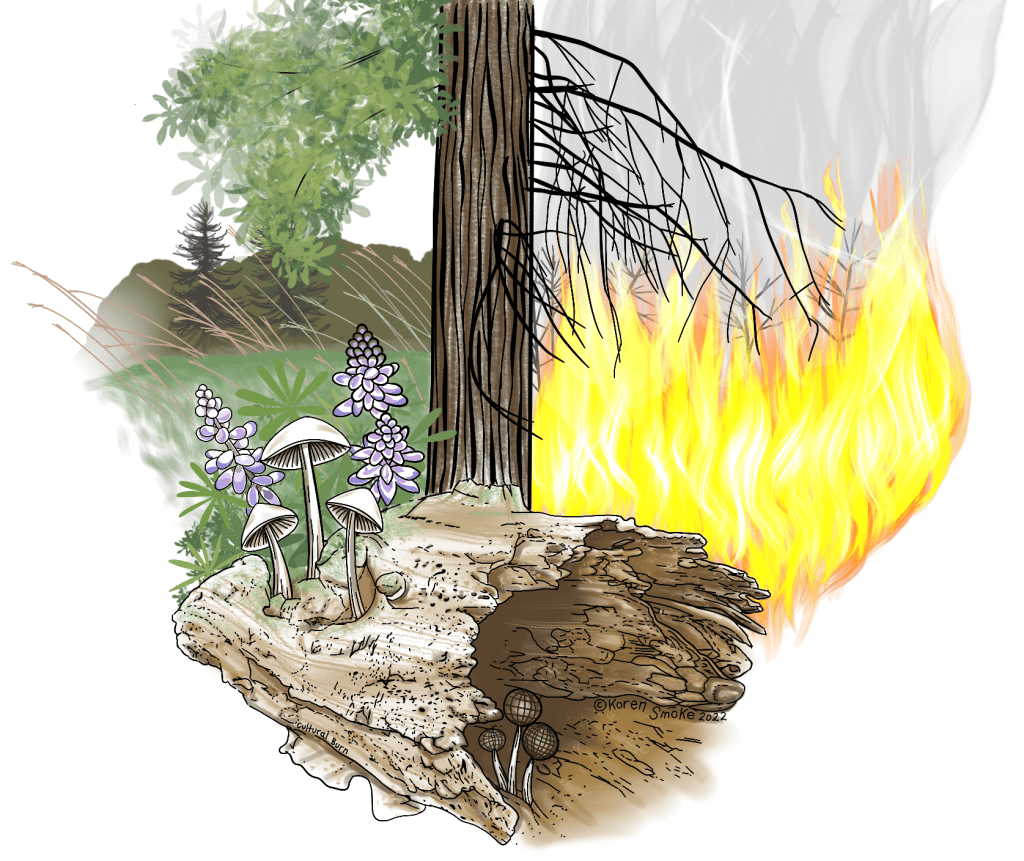
Cultural Burns by Koren Smoke, Michi Saagiig Anishinaabe Kwe, Alderville First Nation, Illustrator for ReReading Catharine Parr Traill: Stranging the Familiar (2022) by Dorothy Lander
https://tryhealingarts.ca/product/book-rereading-cpt/
Posted by Dorothy Lander, co-publisher HARP the People’s Press: H-ealing A-rts R-econciling P-eoples
I listened to Sunday Magazine on CBC radio with host Piya Chattopadhyay in conversation with environmental writer Ed Struzik, a fellow at Queen’s University’s Institute for Energy and Environmental Policy. Both sobering and inspiring, the message was that we need to learn the lessons from the devastating wildlife fire in Jasper; we need a national wildfire strategy.
https://www.cbc.ca/radio/sunday/the-sunday-magazine-for-july-28-2024-1.7275114-2024-1.7275114
Dr. Struzik pointed out that Parks Canada has been working well over a decade to prevent something like Jasper happening. I had an AHA! moment when he pointed out that we need to develop a culture that respects fire, taking up the Indigenous practices of long ago – the practices that were in place before the colonizers criminalized the craft of cultural burning and thinning of forests.
I grew up on a hill overlooking Rice Lake, part of the Trent-Severn Waterway in southern Ontario. Rice Lake appears in the mythology of Samuel Champlain’s first encounter with the Indigenous peoples living on its shores. The Chief grunted “Pem-a-dah-de-coma” — Lake of the Burning Plains — explaining to the Frenchman that each year his people set fire to the grass on the surrounding hills as a way to create abundant food for the deer.

As a child I learned about cultural burning when my father read aloud Catharine Parr Traill’s 1852 novel Canadian Crusoes: A Tale of the Rice Lake Plains. During the pandemic, my husband and I re-read this 19th-century story aloud, the first work of fiction for children by a person living in Canada. I burst into tears, as I heard myself saying the words of white supremacy. Arising from this life jolt, I wrote my decolonizing memoir ReReading Catharine Parr Traill as a call for a reflective reading of Canadian Crusoes to form educational and climate action programming in schools and community education.
As a child I did not take in the import of the many survival practices that the Mohawk girl Indiana introduces to the three settler children who are lost in the backwoods. When settler child Hector expresses surprise at the different growth of the oaks, Indiana describes the conservation practice of setting fire to the bushes in early spring to promote the growth of the grass for the deer and prevent the increase of the large timbers.

“The fire passes so rapidly over that it does not destroy many of the forest trees,only the dead ones are destroyed; and that, you know, leaves more space for the living ones to grow and thrive. I have seen, the year after a fire has run in the bush, a new and fresh set of plants spring up and even some that looked withered recover. The earth is renewed and manured by the ashes, and it is not so great a misfortune as it first appears.” – Indiana
Indiana’s advice sounds much like Ed Struzik’s recommendations that we develop a culture that respects fire, a culture that learns to live with fire. Echoing Indiana, he describes how burning the forest removes the canopy so berries and root vegetables will grow and provide food for grizzlies, bears, moose and elk.
Indiana’s description of cultural burns resemble the prescribed burns advanced by the Nature Conservancy of Canada, which has identified the Rice Lake prairie and oak savannah as one of the world’s rarest and most endangered ecosystems.
The fire managers for Parks Canada observed that the Indigenous firefighters don’t look back at fire in horror. They understand fire. We settlers too need to learn to live with fire and, as Ed Struzik urges, become masters rather than slaves. We settlers need to learn these lessons from our Indigenous hosts.