This Land is Made in Canada for You and Me
This Land is Made (in Canada) for You and Me by Dorothy Lander Every act of art is an

by Dorothy A. Lander
We are Trees
When the forest breathes out, you breathe in. When the forests thrive, you thrive.
When the forest lives, you live.
– Suzanne Simard, 2026
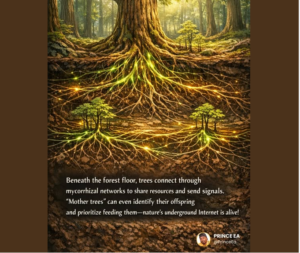
In May 2026, The Halifax Examiner reported on Suzanne Simard’s visit to Nova Scotia to launch her book When the Forest Breathes. It reminded me of the existential reality that “we are trees.” Her 2021 Finding the Mother Tree had already given me a new understanding of trees’ communication networks. But I had no sooner written these above sentences when this image surfaced on Facebook: a powerful prompt to keep on writing.
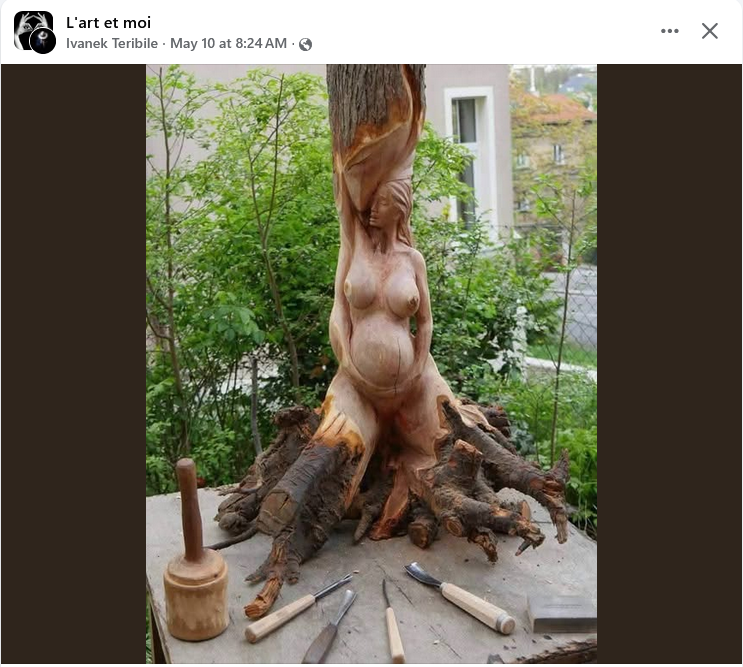
In 2008, I had first heard the We-Are-Trees assertion from birth keeper and placenta scholar Nané Jordan in Lower East Side Vancouver on my SSHRC-funded TransCanada Whistlestop Tour when we travelled via Via Rail to meet with artists and popular educators across this vast land.
On that occasion, Nané told our gathering of women artist-educators, “I’m obsessed with placentas.… I really like the bloodiness of birth.” We were hearing for the first time about this symmetry of placentas and trees.
The placenta is fascinating because it has a baby side and mother side and is in fact entirely grown by baby, yet it is attached to the mother and it is how we grow. The unexpected thing for me about learning about midwifery has been the placenta and the almost metaphoric beauty of what it does and what it is. It is this organ between connectivity and growth and nurturance and it looks like a tree and it is a tree. It has roots. [Nané holding up pictures] So this is from a friend’s birth and I think it is her second or third baby and I was thinking of that time in my life of how— oh my, I was at all my friends’ births—how radical was that?
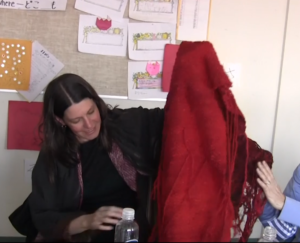
Nané then proceeded to show us the placenta cloak that she was weaving.
The Q’uran affirms the bloodiness of human beginnings. Allah created the human from a clot of congealed blood. This alaqah (clot) begins with the fetus clinging to the placenta.
A decade on in 2017, Nané asked Dorothy to review her book Placenta Wit: Mother Stories, Rituals, and Research, and Dorothy’s commentary is featured on the back cover. Today, Dorothy and Nané understand the symmetry of placenta and trees as more than metaphorical. But in 2017, Nané introduced her book with the statement:
My favorite placenta metaphor is that of a tree. The placenta, with its circular mass of vascular networks resembles interlacing tree roots as they extend into nourishing soil. The umbilical cord is similar in form to the long trunk of a tree growing up from these roots, while babies are the fruits and flowers on this human tree of life. There is a deeply symmetrical relationship between placentas and trees, as if we ritualize through our bodies a sacred interconnection of living forms. And isn’t there something radical about placentas? Radical, as in its etymology of “going to the roots.” Placentas are radical, red, and bloody raw, the very rootsy material of our maternal origins.
Dorothy in turn wrote in her review about “these life-affirming and culturally sensitive metaphors and practices for the care and disposition of the placenta, which together effect the relational human beings that we shall become.” I paused on that word, “relational,” which underpins Indigenous epistemology of “all my relations.” In Finding the Mother Tree, Suzanne Simard spells out how this kind of transformative thinking is what will save us:
It is a philosophy…[that] begins by recognizing that trees and plants have agency. They perceive, relate [italics mine], and communicate;…They cooperate, make decisions, learn, and remember—qualities we normally ascribe to sentience, wisdom, intelligence. By noting how trees…have this agency, we can acknowledge that they deserve as much regard as we accord ourselves. (p. 294)
And by extension, we must accord the rootsy material of the placenta the same care, in timing the detachment from the human mother tree, preserving it, and finding the final resting spot. Christopher Cordon’s in his essay, “A Father’s Placenta Story” in Nané’s Placenta Wit, gives voice to the placenta at the time of the traumatic birth of their first child Shanti (p. 223):
I’m not ready, it resisted. I need time to separate as I must, to release this grasp, this bond as intimate as any connection can be, it pleaded. I am as much a part of this mother as she is of me, as we have grown together for nine months, as we have become one in this interconnected bundle of tissue and blood. As determined as you are to rip me out, I wish not to relinquish my rootedness from this place. Not yet, I know my job is almost done, it reasoned. Not quite yet.
Fast forward to my next interaction with Nané Jordan at an online conversation on May 27, 2023, which featured her chapter in Art-Care Practices for Restoring the Communal edited by Barbara A. Bickel and Michael Fisher. This was at a time in Nova Scotia when we were still cleaning up after Hurricane Fiona, one of the most powerful and destructive storms in Canadian history. I was struck by the resonance between the uprooted trees where we live and the separation of the rooty placenta from mother and baby. I sent Nané a photo of our own ‘placenta’ tree.
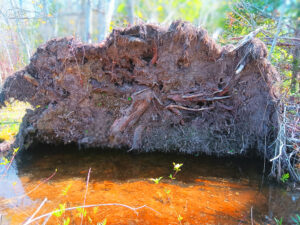
As I write this in May 2026, this same uprooted tree is beginning to leaf; the time is “not quite yet” for root to separate from mother.