This Land is Made in Canada for You and Me
This Land is Made (in Canada) for You and Me by Dorothy Lander Every act of art is an

by John Graham-Pole
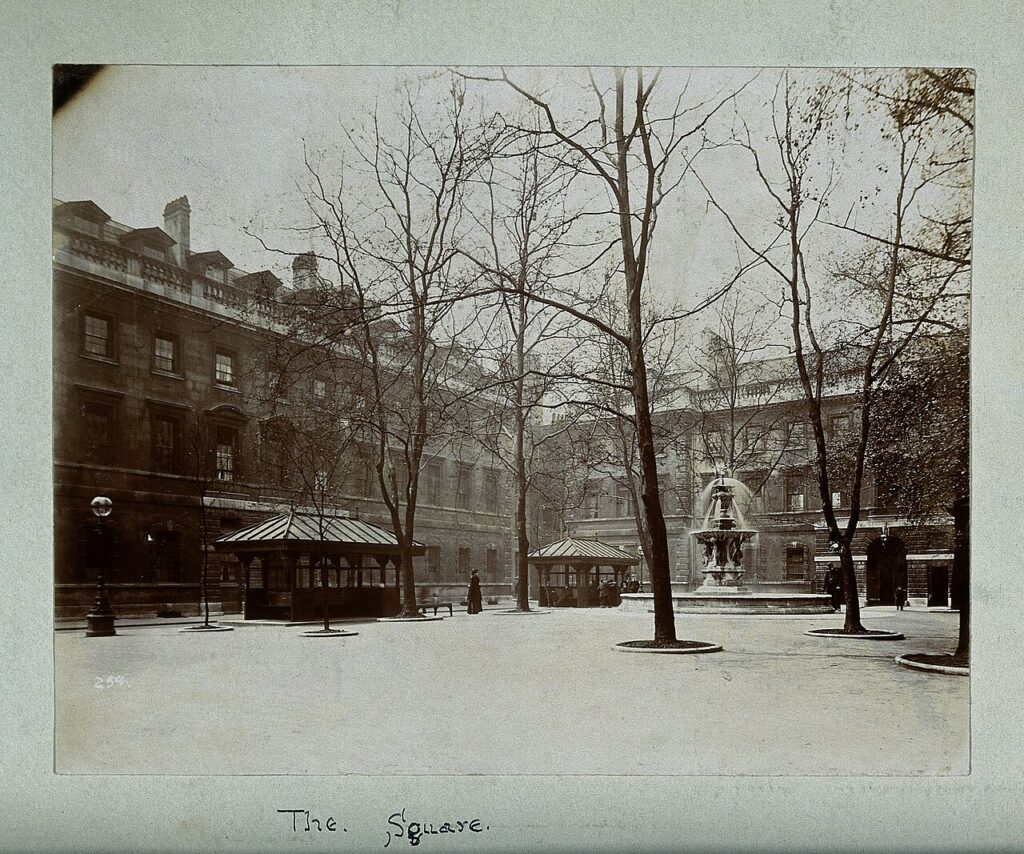
Wellcome Collection Gallery: https://wellcomeimages.org/indexplus/image/V0028932.html
It’s the very first day of January 1967. My first internal medicine internship begins this frosty Monday morning under the shades of St. Paul’s Cathedral in the city of London. Right now it’s 7:46 AM and I’m making my familiar way from the medical college across West Smithfield Market and through the hospital’s West Gate beneath the statue of Henry VIII.*
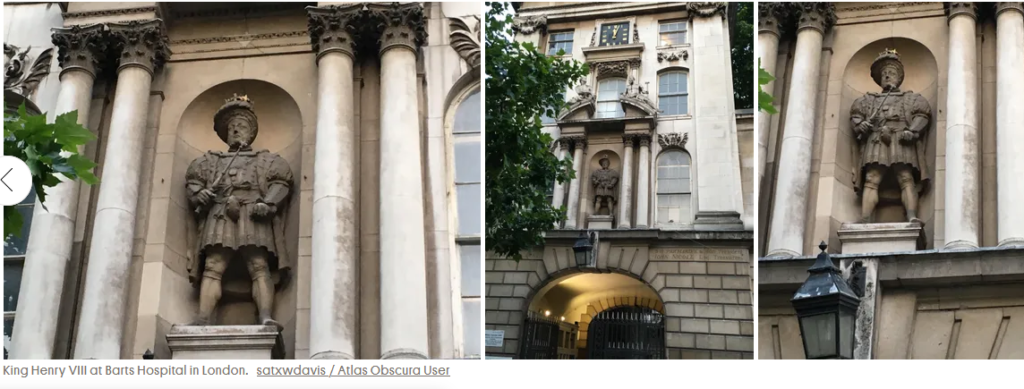
I haven’t the faintest idea how he got himself up there to guard the main entrance to Britain’s most ancient hospital, but right now I’m more concerned with the blanket of snow that threatens to ruin the pristine creases of my white coat. It’s less than an hour since I pulled it fresh out of the box that a hospital porter had left in my locker at the gatehouse. Well, not exactly pristine, because its pockets are already stuffed full of all the essentials I could come up with: tuning fork, otoscope, stethoscope, reflex hammer, handbook of useful medical facts for new interns (complete with their beloved Greek and Latin origins), three ballpoints, a couple of stubby pencils. phone numbers of key hospital services, and three barley sugars for lunch and other brief respites.
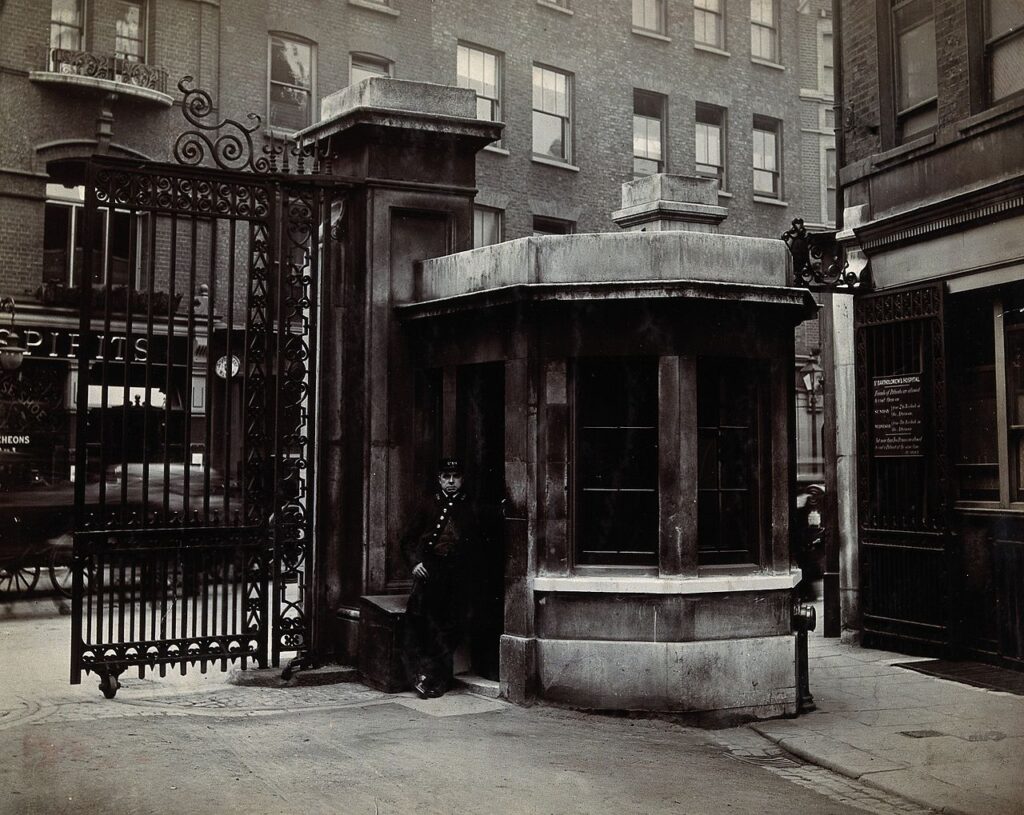
Wellcome Collection Gallery: https://wellcomeimages.org/indexplus/obf_images/b7/ac/2cafef9f8fb6937f38c18e63f63c.jpg
It has been barely a week since I was chasing my three flatmates around the famed Barts hospital fountain for a drunken dunking to celebrate our final medical student Christmas spree together. More hilarious still, we had been tossing a twenty-pound turkey between us, donated by an inebriated Smithfield Market porter as he locked the gates for his hard-earned break. We had quizzed him about how to prepare the beast, but he had no more idea than we did. We had to stuff the thing into the oven till it looked and smelled cooked-through, then the four of us ripped it apart. The tastiest bird we had ever tasted, and the first time any of us had feasted on Christmas dinner minus any trimmings at two in the morning.
So here I am. Still stunned at “winning” my first internship under Britain’s first professor of medical oncology, Gordon Hamilton Fairley. Especially since it was only a month earlier that the dean of the med school—his name happily erased from my memory, though I know he was also Barts’ senior ENT surgeon—had straightened out my nasal cartilage, which Barry had bent way to the left in our brief skirmish in the mud-dry patch of grass in front of our Muswell Hill residence. Barry had been the only Jew in our medical student class, and that single bloody punch on my nose had been payback for other students’ countless antisemitic jokes, which I pretended not to follow. How Barry got me into my Mini that night and drove me to the hospital I’ll never know because I was still plastered and semi-conscious. But to his everlasting credit, he sat beside my stertorous postop form through the few remaining hours of that Friday night. No doubt fast sobering up and remorseful, but secretly proud at getting one blow back for his tribe.
This first-year internship would earn me the handsome sum of 1200 pounds a year, mostly going towards paying off my amassed debts, to the lasting delight of my Barclays Bank manager, who had become almost a friend over our frequent discussions of my overdrafts. I’m twenty-six but look seventeen, and I’ll be looking after people mostly far older than me. Will they have any idea that I’m in sole charge? At least, that’s what it feels like to me. I suppose the word gets out, like gossip in all gathering places where there’s little else to talk about.
“’Nuvver new doc, eh? Get younger every day, they do. ’Ope this one knows wot ’e’s abaht.”
Not that all my patients will be Cockney-born and -bred, because the commuter trains from Guildford and Epsom and the other dormitory towns to the city all stop at Holborn Viaduct, a stone’s throw from the hallowed Henry VIII Gatehouse, to unpack carriage-loads of city stockbrokers and Fleet Street journalists. They’ve taught themselves to have their heart attacks first thing on Monday morning after overdoing it in the garden and the pub over the weekend. Mind over matter, yes, if I had ever given this remarkable fact the attention it deserved.
I’ve picked up a few tips during my final med-student year, primarily not to look to my senior colleagues to help me out. These colleagues include a senior house officer, a junior registrar, a senior registrar, and two consultants, all well above me in the hierarchy. But it turns out that it’s the more approachable and experienced nurses that I’ll be seeking out to help me figure the exact four-hourly dose of morphine to squirt into the fast vanishing veins of a close-to-terminal patient. Which will describe almost everyone I get to look after, because this is one of the first wards in Britain—maybe it is the first—which is dedicated to oncology: that marvellous euphemism for the C-word, which I will never hear muttered even under the almoner’s breath. The reason nobody uses the C-word is for fear that uttering it aloud will give it even more lethal power.
Barts was known as an almshouse before it became dignified as a hospital. It wasn’t even known as a place for healing the sick, having been for several centuries simply a shelter of hospitality and charity for the homeless and indigent. Besides being hired to distribute alms to our mostly indigent patients, the almoners—known more aptly nowadays as social workers—take on every conceivable task that no one else is willing to handle.
How will I deal with those innumerable and inevitable deaths? For this will become the final resting place for almost every Dalziel and Annie Zunz occupant. In the end, it will be my relationship with my patients, not their blessed blood tests and analyses, that will matter. Impersonal much of the time, but certainly intimate. And there’s a reason why they call this medical practice—permanently imperfect: very reassuring. It’s my senior houseman, Alan Bailey—who had managed to fail the 2nd MB exam twice but more than made up for it in self-confidence—who clued me in about the nurses with the tact and patience to deal with my utter greenness. But the buck will always stop with me, and I feel utterly alone, even though the few interns I’ve dared speak to during my student clerkships brush off the terror of their first days.
As I pass through the West Gate I think of the much-lauded dictum that they never closed since Rahere the monk, a much favoured courtier of Henry I and distinguished member of the Augustinian religious order, had swung them open onto Giltspur Street in 1123 to usher in London’s plague-ridden hordes. Not one brick of the twelve-inch-thick walls of the original building still stands, but the primaeval austerity of the place lingers. Memories assail me as I drag my feet across the square, briefly eying Sir Ronald Bodley Scott’s Rolls Royce, which his senior registrar dutifully swings opens so the great man can step out without getting his frock coat dirty after an early-morning visit to Buckingham Palace.
How on earth did I get here? It certainly wasn’t through the urgings of my dad or my Uncle Ken. They may have both graduated from the “Royal and Ancient,” as Barts is fondly known, but Uncle Ken never spoke of it. Instead, he had spent my teenage years when I lived with him after Mummy’s death doing his level best to show me the unrelenting life that lay ahead for me if I persisted in my idiotic intent to follow in his footsteps. As for my dad—well, I saw him for the first time after a twenty-year absence on my twenty-first birthday. A drunken night when never a mention was made of my chosen future. So it comes back to Mummy, to her death from cancer that set me off on my twelve-year-old’s resolve to cure this malignant disease far and wide and forevermore. How could I have envisioned this heartache that would surface a decade and a half later? That every patient draped beneath those white sheets and trundled down five floors to the morgue in the basement would feel like burying Mummy all over again? Remission was not a word I would hear spoken this whole year, let alone that even more elusive one, cure.
My lace-up shoes bring me right back to the present. They were just not made for walking—and walking is to be the primary task of my fourteen-hour working day. No more desks to slouch behind as my lecturers drone on and I switch off. My first day has not even got underway, and I’m already regretting these shiny black lace-ups; even my carefully knotted tie feels burdensome. No one had told this wet-behind-the-ears intern what he should wear, so I had judged it best to polish my shoes and tie a neat knot in my tie until I saw what my predecessors found as acceptable clothing.
How many hours of walking lay ahead? Let’s say twelve hours a day—720 minutes, right?—with thirty new patients to get to know. They will be brand new to me, every one of them, quite apart from the countless new admissions I can expect, especially on a Monday, the weekly on-call day for our floor. The five floors are on-call for 24 hours each, plus one weekend in five. Which means every fifth week I’ll be first on call for emergencies from Friday at 5pm till the following Monday at the same hour. Which leaves me twenty-four minutes each to get to know every one of those already incumbent in apple-pie order up and down the walls of these Nightingale wards. The hardest bit will undoubtedly be their meds, most of which will be brand new to me, even if I did win that honours viva in Therapeutics last summer.
I sense but never glance up at the ancient walls enclosing the wards on three sides, before climbing the worn stone staircase to my wards on the third floor: Dalziel, the men, to my right, Annie Zunz, the women, to my left. I’m being paid to take care of these East Londoners who have put their trust in this ancient system, the centuries of wisdom accumulated here, that has thrust this twenty-six-year-old into the front lines. I guess it’s the best system we’ve got because it’s been around a long time. Do I hear the echo of Rahere’s voice as he hands me down his mantle?
*The West Gate of St. Bartholomew’s Hospital (often called Barts) is officially known as the Henry VIII Gatehouse, which dates from 1702 and features the only public statue of King Henry VIII in London. It is located on West Smithfield.