This Land is Made in Canada for You and Me
This Land is Made (in Canada) for You and Me by Dorothy Lander Every act of art is an

Doctor Dopamine and Muhammad Ali: Is Laughter the Best Medicine for Parkinson’s Disease?
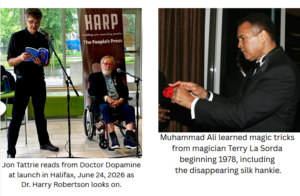
HARP The People’s Press released Jon Tattrie’s Doctor Dopamine: The Extraordinary Life and Science of Dr. Harry Robertson in Halifax on June 24, 2026. As the HARP executive working with Jon Tattrie over several months pre-publication, Dorothy Lander had a niggling feeling in some deep recesses of her mind that she had had an earlier close encounter with Parkinson’s and dopamine. What was it?
The first nudge came from Harry Robertson’s wife Liz Townsend when she and Dorothy realized that they were both Master of Adult Education (MAdEd) graduates at St. Francis Xavier University (StFX) in the 1980s and that Dr. Teresa MacNeil was their faculty advisor.
But the adult education connection did not register until June 2026 when Dorothy’s stepdaughter Susan Napier (daughter of longtime broadcaster with CBC Radio Halifax, Patrick Napier, host of Radio Noon and The Afternoon Show) was rushed to emergency at the same hospital in Antigonish, where Patrick died in November, 2004. Dorothy’s sabbatical year began May 2004, divine timing that allowed her to give uninterrupted loving attention to Patrick at the end of his life. It was the crisis for Susan that ultimately surfaced a two-decades old memory of Dorothy’s encounter with Parkinson’s and the role of dopamine. Two MAdEd graduates part of the Women of Winter Orientation cohort of 2000—Barb Fry and Janice Acton—and Patrick’s palliative care nurse Heather Brander became a grief support group for Susan and Dorothy. Dorothy was Barb’s and Janice’s thesis advisor.
In early 2005, Dorothy, still on sabbatical, proposed that her grief support group of five present their stories of loss at an Educational Biography Conference in San Antonio, Texas, in April 2005, less than six months after Patrick’s death. Four of the five women, all but Janice, attended en force. Together they composed a research article for an adult education journal, which appears on Dorothy’s CV as:
Lander, Dorothy A., Napier, Susan D., Fry, Barb F., Brander, Heather, & Acton, Janice (2006). Memoirs of loss as popular education: Five palliative caregivers re-member through the healing art of hope and love. Convergence, 38(4) (Special Issue on Social Justice, Arts and Adult Education), 121-139.
But it was on the journey home after the conference that Dorothy and Susan had their encounter with Parkinson’s, which then became part of the research article.
Airport magic with Muhammad Ali: Becoming spect-actors in Invisible Theatre
Float like a butterfly, Sting like a bee
Susan and Dorothy were early for their flight from San Antonio to Chicago after their presentation on memoirs of loss and grieving at the Educational Biography conference in April 2005. They took turns walking the corridors and guarding each other’s luggage. As Dorothy was making her way back to our departure lounge, she passed a black man in a wheelchair surrounded by who she supposed were his caregivers. A man came out of his departure lounge and said to the man in the wheelchair, “I have followed your career and just want to shake your hand.” The man and his entourage made their way to the departure lounge and an audible buzz of “Muhammad Ali, Muhammad Ali” began. The digital cameras came out and Ali got out of his wheelchair and stood for endless rounds of picture taking. Dorothy remembered then that he had Parkinson’s Disease. He did not speak and he had the mask-like face that marks this disease, but his eyes sparkled as he posed with women, often putting his arms around them and kissing them, and hamming it up with the men by performing the grade-school trick of rabbit ears behind the head. A performance that had the attention of the whole departure lounge. And then the magic began. Ali, with the expressionless features of a mime, produced a bright yellow silk hankie, and then without a tremor in his hands, he opened his palms to show that the hankie had disappeared. Then he closed his hands, and bit by yellow bit, the hankie reappeared out of nowhere. A man had come to sit right next to Dorothy and Susan in the lounge, explaining that he had scouted out the location of the outlets to use his laptop, and that is why he chose the seat right next to us. When Muhammad Ali began his magic tricks, he marvelled, “Still the showman” and then he too went to shake his hand. Dorothy was reminded of Ali’s famous line to describe his boxing style—”Float like a butterfly, sting like a bee”—and thought how applicable this was to living his dying. As flight time drew closer, Muhammad Ali sat down again, and still the crowd came to him to sign autographs,—sometimes on their boarding pass—which he did painstakingly and often with help from the two women and the man in his entourage. Ali and his entourage were the last to get on the plane to sit in the first-class section. Susan and Dorothy sat opposite each other in aisle seats, and Susan’s seatmate proudly showed her his digital pictures of Ali, before returning to read the latest hardcover Harry Potter book. Almost as if we needed yet another reminder that magic belongs in the palliative care kit of creative arts.
Dialogue on “Airport magic with Muhammad Ali’
So many reflections: Did Ali’s caregivers introduce him to the magic arts, as a way for him to continue to perform, or did he always do magic in and out of the boxing ring? How was it that he was able to do magic tricks, without a tremor? Is this specific to the disease, or is a focus on a specific part of the body a way of inhibiting the tremors? Would the magic arts break down gender and age barriers—in other words, does magic appeal to men, women, and children? It was a marvel that Muhammad Ali was able to exude such charm and expression through his eyes and hands, and to transcend facial expression. Research on mother and infant bonding reveals the multi-faceted muscles that forge the nuances of intimate relationship. In Susan’s practice of bereavement counselling within perinatal health care, she has coined the expression, “Where there is humour, there is hope.” The charm and comedy of Muhammad Ali’s performance in the face of a life-threatening illness, validates this connection.
And then another coincidence! Dorothy was reading on this very flight Groopman’s (2004) The Anatomy of Hope: How People Prevail in the Face of Illness and one of his case studies described placebos as a hope treatment for Parkinson’s Disease.
As more dopamine is lost, the patient finds it increasingly difficult to walk without shuffling, to write smoothly, to laugh heartily at a joke. The term applied to the change in mien is ‘masklike face.’ . . .Placebos caused the brain to release as much dopamine as the active drug. (pp. 187-188)
Could it be that humour and the magic arts act as a placebo to engender hope and healing?
Muhammad Ali’s performance is reminiscent of Augusto Boal’s Invisible Theatre, which typically features actors who have rehearsed a play about a social issue and then act it out unbeknownst to the spectators in a public space. Issues that have been acted out include littering on the Staten Island Ferry (Cohen-Cruz, 1994, p. 228), sexual harassment in the Métro in Paris (Boal, 1992, pp. 6-9), and the shortcomings of the national health system in a ferry-boat in Stockholm (Boal, 1992, pp. 9-11). Ali performed his art of living his life to the fullest in the face of dying, and drew in the audience as spect-actors, who when the “play” was over continued to talk about the social issue to their companions on the airplane and presumably to their families when they got home and showed their pictures and autographs. Boal (1994) defends the charge that Invisible Theatre dupes the spectators.
It’s theatre when we rehearsed it but when we go to the real Staten Island Ferry it is reality. …Invisible theatre reaches very few people. But it modifies people’s opinions. …There are those you reach immediately and those you reach later, indirectly. (pp. 229, 232).
Muhammad Ali died in June 2016, eleven years after that encounter with magic.
Ever the researcher, Dorothy pondered whether humour as a placebo extended Muhammed Ali’s life and his 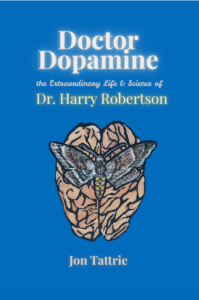 quality of life. She remembered that in Doctor Dopamine, humour threads through so many of Jon Tattrie’s conversations with Dr. Harry Robertson, but it is more in the context of Harry’s life story than his scientific research on Parkinson’s Disease. We are left to wonder if the humour placebo formed any part of Harry’s research?
Dorothy does a word search on Doctor Dopamine and gets 32 hits for “laugh,” 10 hits for “joke,” 3 hits for “humour,” and 6 hits for “fun, funny.” Harry’s humour usually does not take the form of a showman like Muhammad Ali, but rather more self-effacing and ironic.
Does Harry Robertson get a dopamine burst, when he laughs ruefully, often about his father? He laughs when he tells Jon his father and mother “exhibited none of the traits which would have suggested they would be suitable as parents.” He laughs about his maternal grandparents looking into his father: “They found too much information. … He worked selling toys. Death of a Salesman—he was a character very much like Tennessee Williams could have used.”
Humour emerges spontaneously in the dialogue between Jon and Harry. Jon asks: “How do you kill a moth for research? “Very carefully,” is Harry’s response. Harry asks Jon. “Do you have any background in chemistry?” Jon remembering his 51% grade in high school English says, “No.” That generates a laugh from Harry. “You say it as if I had insulted you! ‘What?! You think I could be so lowly as to be a chemist?’” Harry then tells a chemistry joke that goes over Jon’s head. “I have to stop that chemical synthesis going off in the basement,” he says as he abruptly leaves the room. Jon sits there for five minutes before realizing that’s Harry’s way of saying he’s going to the bathroom.
Many stories that Harry tells and that others tell about him emphasize his self-effacing jokes. Harry laughs telling how he chose Western University knowing he could get a decent mark by carefully selecting his courses. “That’s why God created Sociology 200.”
Unlike Muhammad Ali, Harry had no expectation that when he presented from the podium at a scientific meeting, that his audience would hang on his every word or gesture. Harry’s professor at Western, John Steele, told Jon that as soon as “people realized it was about insects, we heard mass shuffling about as people tried to get out of the room in the dark.” Harry and Professor Steele shared a laugh over shuffling scientists. Harry reports a similar response to the talks he gave on his research from Cambridge University. “I went through one entire carrousel to get oriented. Then I showed a second carrousel, but I didn’t get all the way through it. People were getting up and leaving. Others had dozed off. Some of the people who were there that wonderful day claimed that I was one of the people who had gone to sleep.”
By contrast, George Robertson, who met Harry on a 1984 undergrad course in pharmacology, where Harry was a guest lecturer, describes Harry in the showman-entertainer terms that could apply to Muhammad Ali. “He was animated, he was humorous. He liked to put jokes in his talks. He was fun to watch. He made light of things as much as he could.” George remembers a cartoon Harry used, which showed one doctor prescribing a drug to help a patient, and another doctor prescribing a different drug to help the patient survive the side effects of the first drug. Harry used drawings of toilets to show how the brain works.|
Harry’s identity as the jokester is the authentic Harry that his family and colleagues tell about him, and that he tells about himself. Could it be that the placebo that extends the life and the quality of life of someone living with Parkinson’s manifests in the opportunities to be one’s authentic self? Harry’s wife Liz reveals that others saw Harry as a joker. Liz shakes her head as she recalls the bell-bottom pants that he still wore in the 1980s. “Nothing you would say was avant-garde. The contradiction between his brilliance and his need to be the clown wasn’t always all that appealing.” But it was compelling. Harry’s sister Sandra remembers Harry chucking animals at her en route to the outhouse in their childhood in backwoods Ontario.
Harry goes on to suggest to Jon that “we should have an appendix for Parkinsonian jokes” in the book. When Jon asks him for examples, Harry says, “I can’t think of any immediately.” For Jon, that seems like a pretty good parkie joke.
Dorothy poses the possibility to Harry: What if a Parkinsonian Jokes resource could serve as a complementary placebo treatment alongside the high doses of dopamine the drug, which is the standard daily treatment?
Find many more Parkinsonian jokes in Doctor Dopamine, available to order online through the HARP website and at bookstores in Antigonish, Nova Scotia (The Curious Cat) and Halifax (Bookmark). https://tryhealingarts.ca/product/doctor-dopamine-the-extraordinary-life-and-science-of-dr-harry-robertson/