Cross-Border Women’s Friendships: A Herstory of Canadian-American Reciprocity
by Dorothy Lander Inspired by Heather Cox Richardson, Boston College history professor, and her daily newsletter (Letters from an American),

Bugle Weed and White Violets: Home Blooms for Tent City and Come-From-Away Refugees
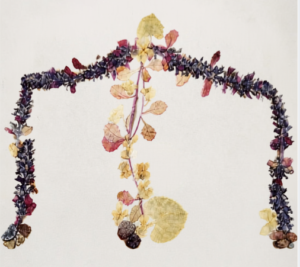
Tent City Halifax with Bugle Weed and White Violets, May 2023 by Dorothy Lander
When a flower grows wild, it can always survive.
Wildflowers don’t care where they grow.
Dolly Parton, 1986, collaborative album Trio with Emmy Lou Harris and Linda Ronstadt
Home is where one starts from.
As we grow older
The world becomes stranger,
the pattern more complicated.
T. S. Eliot, East Coker, Four Quartets, 1943
Who gets to name and claim their country or dwelling place as “home?” The Canadian Alliance to Prevent Homelessness names tent cities as “homeless encampments.” Did the “homeless” signifier for tent cities give the Tim Houston government of Nova Scotia permission to redefine the meaning of home? On August 25, 2026, the Department of Opportunities and Social Development replaced the word “accommodation” in the Income Assistance regulations with “living in a home,” defined as a rented or owned self-contained unit, a lodging-house room or a single-occupancy room in a building. This language change effectively denied people who make their homes in tents the enhanced assistance rate. It effectively denied people living in tents opportunities and social development!! People cannot begin to make ends meet with the Essentials Rate of $475; denying the $300 increase to tent city refugees intensifies the conditions of poverty and hunger and isolation.
Nova Scotia’s most celebrated come-from-away refugees—the Peace by Chocolate Hadhad family—offer a different meaning of home. Both Tareq and Alaa, second generation Syrian chocolate makers, will tell you “Syria, our home by birth, Canada, our home by choice.” Nova Scotia’s home-grown refugees in tent cities tell us they do not have a choice, do not have support from government or community to make other choices for making their home. Home in a tent is where they “start from” and where their efforts to lift themselves out of poverty and flourish like Dolly Parton’s wildflowers get ever “more complicated.”
My response to the memes circulating that begin “Houston, we have a problem” is something like: “Hadhad, you have a solution.” or “It’s the gift economy, stupid!” Last week’s outpouring of tributes to Dolly Parton upon her death at age 80 prompted me to reflect on parallels with Tareq Hadhad of Peace by Chocolate in the spheres of business and entertainment and faith. Abrahamic faith witness guides both Tareq and Dolly, entrepreneurs and performers who grow their lives, their talents, and their livelihoods within the spiritual ground of love, peace, justice, mercy, and human dignity—all values which underpin their personal religious affiliations. By way of extreme contrast, white supremacy Christian nationalism is central to MAGA branding associated with the market economy. Tareq and Dolly do not “brand” their spiritual values; they simply grow their business and make their presentations laser-focused on the gift economy. Tareq is a much-in-demand motivational speaker. The gift economy resonates with Indigenous spirituality of “All My Relations,” which botanist Robin Wall Kimmerer expands on in Braiding Sweetgrass as a covenant of reciprocity that binds every one of us humans to Mother Earth. This covenant calls on us to recognize the “dazzling gifts of the world,” to take only what we need, and to reciprocate the gift. The flourishing is mutual. In direct contrast, the market economy is transactional: the relationship ends once goods and services are exchanged for money in direct, discrete transactions. The gift always moves.
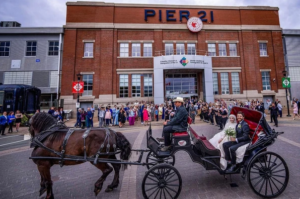
I came face to face with the contrasting realities and opportunities to flourish for home-grown tent city refugees and come-from-away refugees when my husband John Graham-Pole and I had the honour of attending the wedding ceremony of Peace by Chocolate CEO Tareq Hadhad and Mila Zidan at Pier 21 on May 20, 2023. The couple’s choice of place and planning for their celebration was symbolic of their shared roots in Damascus, Syria. Pier 21 operated from 1928 to 1971, opening its doors at the port of Halifax, Nova Scotia, to “welcome the stranger” —a diverse mix of pre-war immigrants, World War II troops, tens of thousands of war brides, child evacuees, asylum seekers, and post-war displaced refugees. Tareq and Mila’s wedding ceremony echoed the opening of Pier 21 in 1999 as The Canadian Museum of Immigration, honouring and weaving together multiple cultures in the celebration—recognition of our Mi’kmaw hosts, Syrian drummers, Celtic pipers, Highland dancers and…and…and….
The Peace by Chocolate story and Tareq and Mila’s wedding celebration challenge the description of Pier 21 as Canada’s Ellis Island. Ellis Island also opened as a Museum of Immigration but its exhibits promoting diversity and the contributions of immigrants and refugees like the Vietnamese Boat People do not square with the stories of immigration-bashing and the scale of deportation of undocumented immigrants in the US that are flooding our air waves and social media. The Donald Trump administration is seeking contracts to build massive “emergency influx facilities” capable of holding up to 3,000 unaccompanied migrant children, which human rights advocates, child welfare experts, and legal groups warn will escalate the risk of systemic cruelty, psychological distress, and abuse. These detention centres are no Ellis Island, no Pier 21. The Canadian Museum of Immigration at Pier 21 actively preserves and displays the history of the more than 100,000 Southeast Asian refugees—including Vietnamese boat people—who came to Canada between 1975 and 1985.
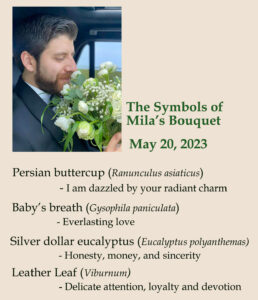
Which brings me to the aftermath of the Tareq-Mila wedding. John and I walked from our luxury airbnb on the Northwest Arm toward the busy traffic route to the Armdale Roundabout and came upon a tent city on a nearby slope. We witnessed signs of home-making and the hum of neighbours sharing their communication devices and their meagre resources—the communal portable potty, the one barbecue pit, the communal containers for recycling and trash. We were witnessing a veritable multi-family home. For me, markers of “living in a home” are the efforts to make it beautiful and keep it that way. We did not see litter on the grounds, nor any signs of anyone trampling on the dense mat of bugle weed and white violets that grew right next to the portable potty. The sight of this magnificent outdoor carpet immediately activated my botanical art practice around the symbolism of flowers for the people in my life. I picked samples of both bugle weed and white violets to press and committed to expressing the symbolism of the tent city flowers and Mila’s wedding bouquet. This is what I came up with. My botanical collage is supposed to look like a tent.
White Violet (Viola blanda). At the entry to the tent city, we knelt down to breathe in the fragrance of this small white violet that hides below heart-shaped leaves: more love symbolism on Tareq and Mila’s wedding day! The sweet white violet, because of its low-lying and unassuming nature, embodies quiet grace rather than loud display. It symbolizes modesty, humbleness, and simplicity. Viola, the classical Latin genus for violets, is adapted from the Greek word ion. Zeus turned his lover Io into a white heifer to hide her from his jealous wife Io. When Io wept over having to eat rough grass, Zeus transformed her tears into sweet-smelling white iona (violets) for her to eat. In LGBTQ+ history, violets symbolize love between women, tracing back to the ancient Greek poet Sappho. The white violet, the only intensely fragrant violet in Nova Scotia, offers an added boon for pollinators. The lowest of the five petals is modified into an extended spur to hold the flower’s nectar. Pollinators need a long proboscis such as that of butterflies to reach the nectar in the deep spur. The colorful flower spikes also draw occasional visits from hummingbirds.
Bugle Weed (Ajuga reptans). Ajuga symbolizes cheerfulness due to its striking appearance. The genus name Ajuga means “not yoked,” as the sepals surrounding the bud are not connected. The species epithet reptans is Latin for “having a creeping habit.” Bees (especially bumblebees) and butterflies frequently visit the nectar-rich and pollen-rich tubular flowers. And the colourful flower spikes draw occasional visits from hummingbirds.
The synchronicity of white violets and bugle weed living in harmony sparked my reflection on their indigenous and immigrant roots and as a metaphor for Migrant-Mi’kmaw cooperative relations. The white violet is native to Nova Scotia and has occupied the land of the Mi’kmaq (Mi’kma’ki) since time immemorial. Bugle weed is an immigrant from its native Europe, northern Africa, and southwestern Asia. As an immigrant, bugle weed receives mixed reports from the human immigrants that they share the land with. We hear it can be useful as a ground cover, but it is invasive and can outcompete native species. Meanwhile, the white violet welcomes the bugle weed, recognizing it as a valued asset to the community. Bugleweed will curb the spread of goutweed, an invasive species: the best (only?) cure for goutweed is to move to a goutweed-free home. And how about the medicinal value of ajuga? We understand it contains tannins that are able to cleanse both people and soils of unwanted toxins. Indeed, we who welcome bugle weed will have no need of a surgeon. Those tannins can stop bleeding, which may be why ajuga is sometimes called the carpenter’s herb. Perhaps helpful for carpenters who sometimes hit their thumbs instead of the nail on its head? And who wouldn’t welcome ajuga to their home, knowing it is resistant to browsing by deer?
But words like “aggressive” and “invasive” and “choking” indigenous species get applied to the bugle weed, disturbingly similar to the rhetoric of politicians regarding come-from-away refugees. Nova Scotia Premier Tim Houston strongly opposed a federal proposal from late 2024 to relocate roughly 6,000 asylum seekers to the province. Tim Bousquet for The Halifax Examiner reported on Tim Houston’s divisive rhetoric, his framing asylum seekers and youth refugees as non-contributors — essentially as an enemy. Houston’s billboard declaring Defend Nova Scotia defines “defense” as an immigration focus on professional recruitment, specifically for healthcare workers and skilled trades. The white violet of Nova Scotia politics — Former PC MLA Becky Druhan — raised her objections.
“I truly do not believe that every story has an enemy. In fact, most stories do not have an enemy. Most stories have complexity, but not enemies. I think it’s important to know that that is the lens through which some see the world and are attempting to frame the world.”
The Atlantic Region Association of Immigrant Serving Agencies (ARAISA), a non-profit umbrella organization that has provided support to the settlement and integration sector in Atlantic Canada for 30 years in collaboration with Immigrant Services Association of Nova Scotia (ISANS), filed a report on strategies to support, develop, and sustain refugee youth employment initiatives in Atlantic Canada. The report affirmed that the majority of the refugee population includes young people who can be an asset to the region.
The parallels with the descriptors contrasting Dolly Parton, who died age 80 in August, and the 80-year-old occupant of The People’s House in the United States are inescapable: empathy vs cruelty, love vs hate. Chronicle Herald cartoonist Bruce MacKinnon summarizes the stark contrast between the gift economy and the market economy.

Dolly grew up with her parents and eleven siblings in a tiny, rustic two-room log cabin in Tennessee, reminiscent of the poverty conditions of those “living in a home” in tent cities in Halifax — no electricity nor running water. In the song she wrote and performed, A Coat of Many Colors, Dolly does not conceal the poverty of her Appalachian childhood. She transformed childhood poverty into a story about human dignity and love. Her clothes were made from rags, and her schoolmates teased her. She knew that “Momma sewed the rags together, sewing every piece with love.” Dolly folds Christian witness into the song: While stitching the coat, her mother told her the biblical story of Joseph and his coat of many colours, making Dolly feel cherished and wealthy in imagination and in her circle of relationships. The gift economy and the covenant of reciprocity in practice can be traced to Dolly’s childhood.
Mary Trump, a clinical psychologist and Donald Trump’s niece, offers critical insights into her uncle’s childhood and home life. She attributes his core behavioral traits—narcissism, lack of empathy, bullying—directly to his upbringing in a deeply toxic family environment. Mary Trump describes the brutally competitive environment in which her grandfather Fred Trump Sr. raised his children. His view of a world divided into “killers” and “losers” and human relationships as purely transactional. His mother’s illness and hospitalizations that began when he was a two-year-old left Donald without a primary caregiver, resulting in a profound deficit of love and security at a pivotal age. Donald’s first home was in a house in the upscale Jamaica Estates neighborhood of Queens, New York City, built by his real estate developer father Fred Sr. in 1940. The house boasted five bedrooms, several bathrooms, a living room with a wood-burning fireplace, a formal dining room, an eat-in-kitchen, a wood-paneled office, a finished basement, and a detached two-car garage. Donald was “living in a house” not a home, according to Mary Trump’s analysis.
Fast forward 80 years to Donald living in The People’s House. He proceeds to gut the historic East Wing of the White House and replace it with an out-of-proportion ballroom, one of his many vanity projects. Using taxpayer’s money and without approval from Congress, crews paved over the historic Rose Garden, designed and nurtured by First Lady Jacqueline Kennedy and desecrated it with trashy Mar-a-Lago décor.
Donald is “living in a house” without the presence of his legal wife Melanie most of the time. His is not a home filled with love. Bob Rae in his piece in The Toronto Star (Sept. 4, 2026) echoes Mary Trump’s analysis of Donald’s childhood shaped by his father’s view of the world divided into “killers” and “losers.” “For Trump, there is a winner and a loser in every economic transaction, someone who comes out on top and someone else who comes out on the bottom. This is an iron law for him — no exceptions.”
Robert Reich, another 80-year-old, expands on the Donald-Dolly contrast in his substack:
“Even at 80 years old, she was still bringing Americans together. At 80, he continues to tear us apart.
She always stood for the underdog. He stands for the overlord. She was among the most generous people in American public life. He is the most self-centered. Hers was a voice of clarity, courage, and hope. His is the voice of cruelty, corruption, and incompetence.”
Evoking parallels with Dolly’s experience of “living in a home,” Tareq tells how his whole extended family lived in an apartment building in Damascus, Syria and 25+ people would gather for Saturday night dinners around his grandmother’s giant table. That all changed in 2012: they lost their home and chocolate factory when Damascus was bombed during the Syrian Civil War. They became refugees. In 2016, Canada welcomed the Hadhad family to Antigonish, Nova Scotia through the non-profit charitable society Syria-Antigonish Families Embrace (SAFE: https://www.safeantigonish.ca/) using Canada’s Private Sponsorship of Refugees program. The news of the Hadhad family passing on the gift has not received the level of attention accorded to Dolly’s generosity, especially Dolly Parton’s Imagination Library, which has distributed more than 330 million free books to children from birth to age five worldwide. Peace by Chocolate gifts/donations are inspiring for a start-up company that has been in business for less than 10 years. Peace by Chocolate donates 3% to 5% of its profits to their registered non-profit, the Peace on Earth Society, which focuses on peace building, refugee aid, and crisis response.
This covenant of reciprocity is sealed in its response to the 2016 Fort McMurray wildfires. Soon after having arrived in Canada as refugees who had lost everything, they donated their early profits to the Canadian Red Cross Relief efforts and continued with a percentage of profits from Provincial chocolate bars. In 2022, Peace by Chocolate formally partnered with World University Service of Canada (WUSC) to launch the Peace by Piece chocolate bars with $1.00 from every bar directly funding the WUSC Student Refugee Program. This program combines resettlement with higher education, sponsoring young refugees to come to Canada as full residents and study at one of over 100 post-secondary institutions. Peace by Chocolate keeps adding to its chocolate bar inventory with the names of the causes and organizations that its sales support. The “Welcome to Canada” bar supports national and community-level refugee protection programs through Refugee Hub. A portion of sales from the bar labelled “Nitap” (meaning friend in Mikmaq) goes to Paqtnkek Mi’kmaw Nation. In partnership with the Canadian Mental Health Association (CMHA), it raises money through the “Peace of Mind” bar.
Returning finally to “Houston, we have a problem:” If our government can dole out $2 million for an airborne survey of the geology of Nova Scotia to support the mining and fossil fuel industry, it can find a measly extra $300 a month for tent city refugees. They cannot live on bugle weed and white violets. Like all of us, they need bread and roses.
DISCLAIMER: I used an AI search engine to find original sources for details of the childhood homes of Tareq, Dolly, and Donald. But the non-human AI could not possibly imagine and craft a story about the home life origins of the “giving” lives of Tareq Hadhad and Dolly Parton and the contrast to the childhood origins of the “taking” life of Donald Trump. Only human creativity could come up with that. I used an AI search engine to lead me to original sources for the symbolism of bugle weed and sweet white violet. Only my human creativity could have developed the Migrant-Mi’kmaw metaphor of bugle weed as the immigrant/refugee species and white violet as the native species.