This Land is Made in Canada for You and Me
This Land is Made (in Canada) for You and Me by Dorothy Lander Every act of art is an

By John Graham-Pole
I’ll start with two very recent quotes I just heard:
Pope Leo XIV: “ART is not some kind of superfluous luxury that can be eliminated from our lives. It is a crucial part of the human experience”
Tony Morello, lead guitarist for Raging Against the Machine: “Every act of ART is an act of resistance” (Power of the People Festival, Columbia, Maryland)
***
I began my doctoring life sixty years ago, in 1966. At last, I was a fully paid-up medical scientist! But I gradually and unknowingly morphed into an artist in medicine. One who practiced the Art of Medicine.
Science and Art in Medicine are inextricable. I’ll tell you how I found this out. My first 20 years, I did biomedical science in the form of a long trail of research projects. With my patients as my research subjects.
Then in the mid-eighties I became burned-out. I had become a tenured full professor, I had gotten national grant funding, and I had published 70+ papers in peer-reviewed journals. But I felt I had lost my way. Too many of my patients were still dying young, and their suffering and that of their families distressed me terribly. They had become my treatment protocols, no longer people. Very dehumanizing. But one morning, I woke at 4am with the fragment of a poem in my head. Where on earth did this come from? I hadn’t written a poem in 50 years. The day before, I had been sitting with a 16-year-old girl for many hours, as she died. She was on a ventilator in the PICU, so she couldn’t speak because of the endotracheal tube in her larynx, but she had a small board propped against her knees. And she scrawled this message upon it: “Don’t leave me!” “Don’t leave me!”
So I didn’t leave her. I settled in and sat beside her as close as the convoluted ICU equipment would allow. I stayed very close to her, holding onto her slowly wilting hand. The nurses brought me snacks and drinks, and I took a few bathroom breaks. This is the poem that must have been forming in my subconscious:
Cell Shed
I lean in among the plastic tubes besetting you,
my breath voluntary, yours coerced.
Our cells mingle, each with the other’s
spilling in spindrift of air‑water‑ice between mouths.
You, going, dying, take my life to rest.
I, living, left, draw in, exhale your seed.
I was exchanging my own fully alive breath droplets with her quickly dying ones. She died late in the evening, and mercifully no one tried to resuscitate her this final time. That dear, brave child had asked for only minimal sedation, because she wanted to be as alert as she could be for as long as she could be. It was a peaceful death, as far as we can judge these things. Though can any death in the young be entirely peaceful?
After this, I started waking up at four every morning with fragments of poems in my head. With my patients always as subjects. Almost always the sickest ones, and sometimes I wrote requiems for those who had recently did. This raw start rekindled within me a lifelong love of words. It took me years to figure out this was exactly the kind of therapy I needed. Poetry therapy.
I wrote an article in a magazine called House Calls that was distributed to all the doctors in Alachua and surrounding counties. I asked my colleagues to explore the place of art and artists in Alachua and surrounding counties. I asked my colleagues to explore the place of art and artists in the practice. Not one doctor responded, but a doctor’s wife did — Dr. Mary Rockwood Lane, who is married to Dr. Tim Lane, and orthopedist. Mary went on to become a nursing professor; she is a gorgeous painter, she was thrilled at the prospect of bringing artists into Shands Hospital—and she also happened to know almost every artist in town.
And that was all it took. Mary and I learned very early that golden rule: apologize later, don’t ask permission ahead of time. So we told no one our plans who might disapprove. Our very first artists, Stuart Pimsler and Suzanne Costello, and their Dance & Theatre troupe performed in the Shands Atrium, then led frequent workshops with caregivers, mostly nurses. Stuart describes these experiences at Shands in his book The Choreography of Care, published by HARP the People’s Press in 2021. Then we brought painters and musicians into the Bone Marrow Transplant Unit, which I happened to be co-directing (so no permission asked). Helen Welsh was at that time the head nurse on the unit, and she was entirely supportive.
So it began, A year later, I proposed to Mary that we go talk to the hospital administrators asking them for money, because the artists had been working for nothing. Paul Metts was CEO at the time, and after we had presented the data we had collected about the huge benefits of art at the bedside, he simply asked us: “How can we help?” Mary and I hadn’t talked about any details, so I blurted out: “We want to pay our artists. How about $50,000 a year?” Paul looked down the two rows of VPs, saw no apparent protests, and quickly answered: “Oh, I think we can handle that. We’ll create an account for you to draw on.”
We ran out of there before he could change his mind.
Soon after this, two of our dancers-in-residence, Jill Sonke and Rusti Brandman, both of whom were on the faculty of the College of Arts, proposed the brilliant idea of created the Center for Arts in Medicine within the College. This Center has gone on to become an international leader in arts health research, education, and practice. Today, the Center boasts an international journal Perspectives on Arts in Health, and it is affiliated with a PhD in arts and medicine.

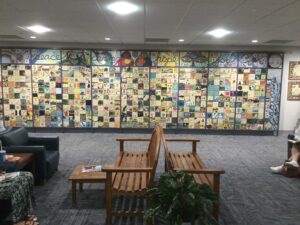
A highlight of my closeness to the core group of artists working at Shands came when one artist, MaryLisa Kitakis, asked if I’d ever considered becoming a notary public. MaryLisa was our primary visual artist who, among many other things, led the painting of ceramic tiles and ceiling tiles on several wards.
“Lance and I are planning to get married,” MaryLisa told me. “You said you’re a Quaker,” she said, “and I went to a Quaker wedding recently, which I really enjoyed. Real simple—and I especially liked how everyone present signed the wedding certificate.
It wasn’t too hard to get a notary public license in Florida. Within a month, I was ready to marry MaryLisa to Lance.
“By the way, we’ve decided to do it on the beach,” MaryLisa tells me. “At St. Augustine. You cool with that?”
Mary Lane has a beach house that can accommodate about ten of us, and on the appointed day, we decamp to the beach, to find all the preparations have been made. MaryLisa is floated out to sea on a bier in her wedding gown by four strong men in swimming trunks, whilst Lance awaits his bride on the beach surrounded by dancing girls. I pronounce them husband and wife, and every single person present signs their marriage certificate in the Quaker tradition. The beach party goes on through most of the night.
During my decades-long career as a pediatric oncologist, I have witnessed a lot of tragedy through encounters with suffering and death. But I’ve also seen countless examples of awesome resilience and creativity among young people. A twenty-one-year-old patient of mine with intractable cancer, Karen Haas, created a coloring book for people young and old, entitled I’m Having a Bone Marrow Transplant. It has been widely distributed by the Leukemia Society of America.

Close to her death, I had to break the news to her in a crowded hospital clinic that her own bone marrow transplant had failed her. That she wasn’t long for this world.
Karen, an irresistible joker as well as a consummate artist, snapped back:
“Hey, Doc, dying I don’t mind—but just not in diapers, okay!”
Karen was a consummate artist, in her living and in her dying.