Mugwort (Artemisia vulgaris) is a Radical Environmentalist
Let me introduce you to Mugwort, my newfound ally in addressing our ecological crisis: an ancient climate witness and radical

Inspired by Heather Cox Richardson, Boston College history professor, and her daily newsletter (Letters from an American), which connects breaking political news directly to past eras in American history, I decided to write my own letter in response to the shattered Canada-America relations evolving from the executive orders of US President Trump and his bowing-the-knee henchmen. And through the lens of cross-border women’s friendships in the 19th century. Consider this a Letter from a Canadian.
The written records of the cross-border friendships of the women in the Woman’s Christian Temperance Union are my source of choice from this era, given that the WCTU had more active members and broader mainstream acceptance in North America than formal organized suffrage associations. By 1890, the WCTU was the largest women’s organization in the United States and Canada, boasting tens of thousands more members than dedicated voting rights groups.
I grew up in a temperance family and church community in rural southern Ontario, just a few miles away from the childhood homestead of the first President of the Dominion WCTU, Letitia Creighton Youmans. I can attest to the social acceptance of women temperance activists as moral guardians of the home motivated by Christian values, which deftly disguised their radical stances that took on the patriarchy—their “woke” commitment to Diversity, Equality and Inclusion (DEI). Their activism extended well beyond a focus on alcohol and tobacco abstinence, to women’s rights related to dress reform (trousers!), riding a bicycle, property succession for widows and single moms, their own bank accounts, and what we now refer to as Gender Based Violence (GBV), especially economic and physical violence. I was introduced as a child to the WCTU friendships across borders. This photo of three WCTU Presidents all sporting the White Ribbon emblem—Frances Willard (1839-1898); Margaret Bright Lucas (1818-1890); Letitia Youmans (1827-1896—appears in Letitia Youmans’ autobiography entitled Campaign Echoes.
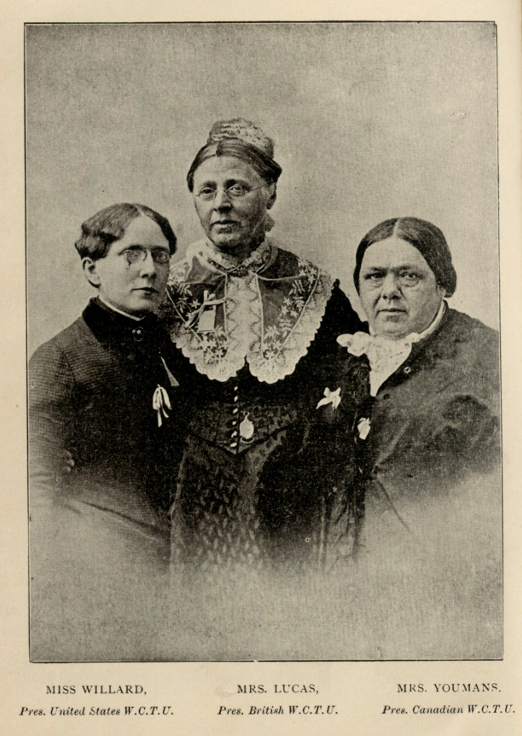
Campaign Echoes (CE) is a primary source for connecting women’s cross-border friendships to the news flooding our airwaves today. But first, some background to the reciprocity discourse.
In the pre-Confederation era, reciprocity was the encapsulating term for promoting free trade of raw materials between British North America and the United States—the Canadian-American Reciprocity Treaty of 1854—and became a deciding factor in federal elections. Higher tariffs to protect manufacturers helped John A. Macdonald and the Conservatives win the 1878 federal election. Liberal support for protectionist policies in a new reciprocity treaty with protectionist policies helped Wilfred Laurier win the 1896 election and stay in power for 15 years. Then in 1911, voters repudiated freer trade with the US and the Liberals lost the election to Conservative opposition leader, Nova Scotia-born Robert Borden. His campaign manifesto on opposition to reciprocity pointed to weakening interprovincial ties, the potential interlocking of American and Canadian financial systems, and exposing farmers to global competition. An echo of Trump’s 51st-state threats to Canadian sovereignty, Republican President William Howard Taft urged Congress to pass it and during a February 14 speech, Speaker of the House Champ Clark, a Democrat, supported the deal with his hope to “see the day when the American flag will float over every square foot of the British North American possessions clear to the North Pole.” Then as now, Canadians resisted the absorption of their country by our neighbour to the south. https://www.tvo.org/article/how-freer-trade-with-the-us-lost-the-liberals-the-1911-federal-election Reciprocity and annexation and prohibition have all disappeared from the discourse but women’s resistance to male-dominated government policy continues in editorial cartoons. John Wilson Bengough was the genius behind the political cartoons of the day.
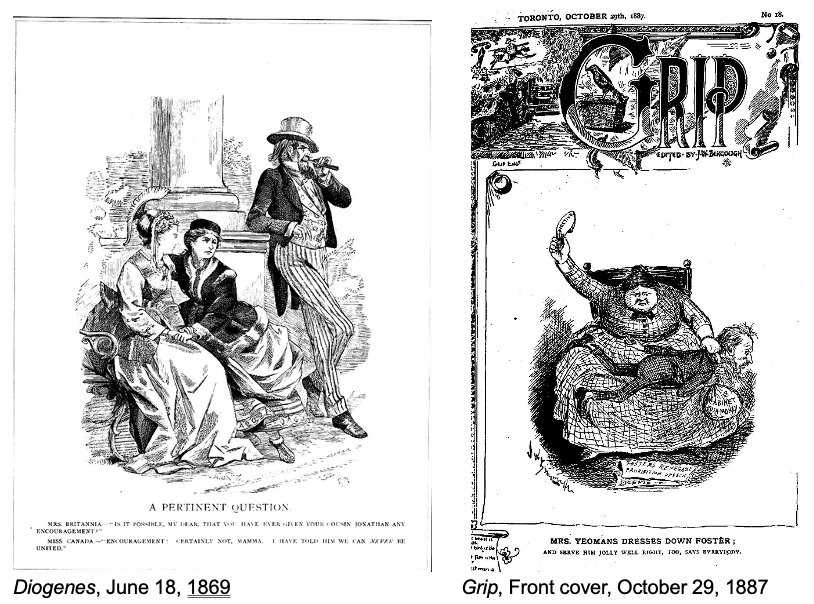
Ontario WCTU President Letitia Youmans gives cabinet minister Hon. George Foster an “exemplary trouncing.” Professor Foster as a “noble knight of prohibition” came up from Ottawa to address the WCTU convention and “his speech was the exasperating platitudes about the country not being ‘ripe,’ the wisdom of high license for the present etc. etc.” Invariably visual and textual references to Letitia Youmans associate her considerable girth with her social action. Prohibitionist Bengough tells how Mrs. Youmans “metaphorically laying him [George Foster] over her ample knee, she gave him the most effective castigation that any public man in Canada has ever received.”
Canadian cartoonist Michael de Adder’s images can be found on platforms like Counterpoint and Substack and in multiple Canadian and American publications, including this one (below) in The Globe and Mail, December 30, 2024.

Reciprocity is now appearing in the context of Indigenous stewardship of the earth and the gift economy as the counter to the transactional market economy. In Braiding Sweetgrass, Robin Wall Kimmerer tells how “we are all bound by a covenant of reciprocity.”
Kimmerer reminds us that our elders say that ceremony is the way we can remember to remember “that the earth is a gift that we must pass on, just as it came to us.”
Canada cancelled the joint U.S.–Canada ribbon-cutting ceremony for the Gordie Howe International Bridge when Trump announced a 50% tariff on Canadian goods. Canadian officials stated that holding a joint cross-border celebration during a sudden trade dispute and tariff threat was inappropriate. On July 28, 2026, descendants of Gordie Howe, the Canadian hockey legend, were among the first to cross over the Detroit River, which separates the Motor City from Windsor, Ontario. A coincidence? Trump’s 50% tariffs on roughly $20 billion worth of Canadian goods covering over 500 product categories, include hockey sticks. Other items enacted under Section 338 of the Tariff Act of 1930 include wine, cement, dairy products, swimming pools, furniture, fishing rods, clothing, and wigs.
Compare this to Letitia Youmans’ dreams in the 1880s for a ceremony at the Suspension Bridge at Niagara to celebrate the passage of a border-crossing prohibition law, beginning with July first, Dominion Day, and closing up with July 4th, Independence Day. [Dominion Day was the original name for what is now Canada Day.]
The assemblies shall meet at Niagara, where the two countries are tied together by the Suspension Bridge. … the women of the W. C. T. U. to lead the van; the United States women to plant the Stars and Stripes on their side of the river, and the Canadians to erect the Union Jack on their side; each part to have bunting enough to meet in the centre of the bridge, where the two flags are to be tied together with white ribbon; the American Eagle to poise on the top, while the British Lion is to crouch underneath; the Eagle to see that no Canadian whiskey crosses over to his domain, while the Lion guards the Canadian shore from Yankee rum. Thus we will have annexation in spite of the politicians; and the best reciprocity treaty that could be enacted. [CE: 205]
In the one chapter of her book, Woman and Temperance,which Frances Willard devotes to Canadian leaders, she praises Letitia Youmans for strengthening the ties of “our temperance ‘Reciprocity Treaty.’”
Her cheery greetings and unfailing bonhomie have greatly helped to strengthen the ties between the two sides of the line, and her favourite prediction about “the women tying together across Lake Erie, the Union Jack and Stars and Stripes with ribbons that are total abstinence badges …” never fails to “bring down the house.” [Willard 1883: 602]
In 2026, imagine loud cheering from Letitia and Frances upon hearing of the removal of American alcohol from liquor store shelves in many provinces as the Canadian response to tariffs. The parent company of American alcohol producers — such as Jack Daniel’s whisky and Woodford Reserve bourbon — laments that sales to Canada dropped 62 per cent during the latest fiscal quarter compared to a year ago.
***
In 1883, Letitia Youmans’ travels took her to Stanstead, a borderland between the United States and Canada where a W.C.T. Union had already been formed. This border town has also been source of a recent rift in Canada-America relations. But also testament to our solid friendship that can withstand the cruel whims of the US President. In 1904, the Haskell Free Library and Opera House opened on that border with free access Canadians via the library’s only entrance on the American side. Once visitors enter they can step from one side of the black tape running under its bookshelves crossing into Vermont, and another step back into Quebec. It was built to symbolize the friendship between our two nations—no customs lines, no need for a passport. Then in 2025, Trump saw it as another way to pick on Canada and literally closed the door to Canadian visitors. We had to drive to a port of entry and wait in line. Just to go to the library down the road. The citizens of both countries weren’t having it. Within weeks donations were rolling in from across both countries, not just Vermont and Quebec. When the library had six figures in hand, they converted an old emergency exit into a real entrance on the Canadian side. In the spirit of reciprocity, the ceremonial ribbon cutting took place on June 10, 2026 with a crowd of officials and neighbours from both countries.
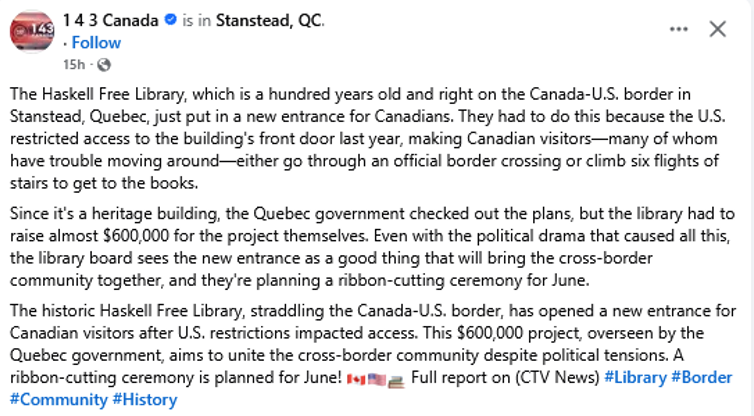
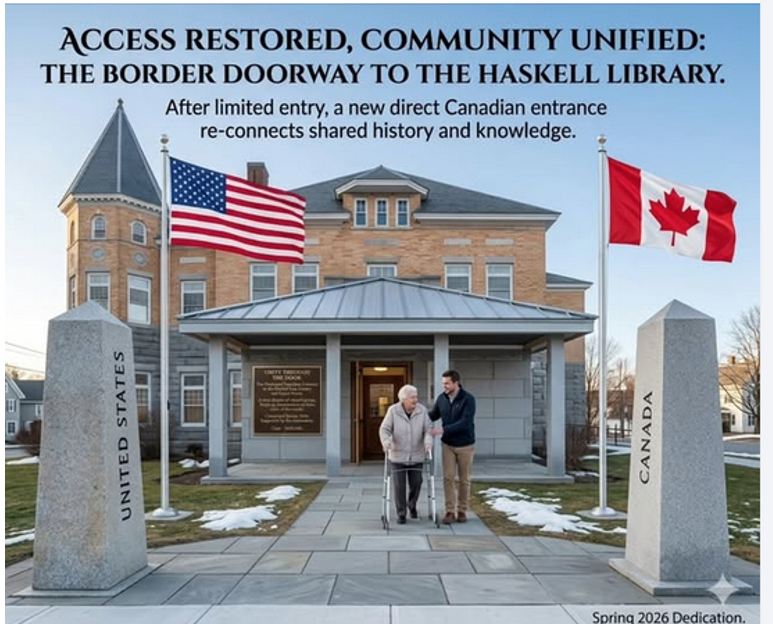
Friendship and neighbourly hospitality figured in Letitia’s experience at that same border.
A letter from the secretary informed me that I had three engagements for the Sabbath: At 10:00 a.m., at Stanstead Plains; at 3 p.m., for Rock Island, Vermont; at 7:30 p.m., Beebe Plain. I showed the letter to my hostess, saying: “That is a regular imposition; I only agreed to speak in the town of Stanstead, and here they are about to drag me to the United States, and back again.” She laughed heartily, and said: “You don’t understand the geography of the place. Stanstead town is called Stanstead Plain; Rock Island is really a part of the town—some of the buildings, a part of them in the United States, and a part in Canada; and Beebe Plain less than a mile from either place.” Here I found, as I often did, it was best not to cross the bridge until I got to it. [CE, 245-246]
The earliest, and only, Customs House east of St. John’s, Quebec, was established at Stanstead Plain in 1821 and for good reason. “It was on the stage route from New England to Montreal, one of the busiest and most important points of entry on the border.” Letitia Youmans does not provide any details of her mode of transportation in 1883 but I speculate that her point of entry took advantage of the Massawippi Valley Railway between Lennoxville and Newport, which was completed in 1875, and Stanstead Junction, later to become Beebe Junction. This border town was an earlier source of squabbling between American and Canadian officials. This 45th parallel “chosen as the dividing line between British North America and the newly formed United States of America in the Treaty of Paris in 1783” challenged the conventional promotion of the 49th parallel as the world’s longest undefended border.
Trump’s mercurial assaults on Canada-America relations, range from exorbitant tariffs, accusations of negligence causing the spread of wildfires and smoke south of the border, accusations of loose borders enabling drug trafficking, and … and … and …
Women’s historical cross-border friendships offer hope and instruction for how to resist these attacks.