Bugle Weed and White Violets: Home Blooms for Tent City and Come-from-Away Refugees
Bugle Weed and White Violets: Home Blooms for Tent City and Come-From-Away Refugees Tent City Halifax with Bugle Weed and

St. Bartholomew’s Hospital
By John Graham-Pole, MBBS, MD
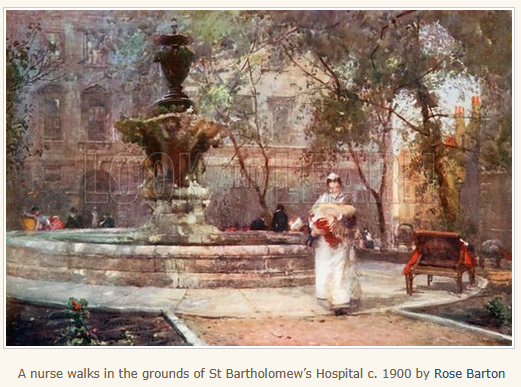
I wrap my skimpy white coat about me, shivering under the January snowfall as I cross Barts Square heading for the Med-Surg block. Whose idea was it for doctors to don white coats in January, anyway? Is it to give us an air of spotless sterility? Hardly realistic, given the bloody messes we medical interns get into within minutes of every working day and night. Or maybe we’re supposed to look like we just tore ourselves from our research labs to spare a few precious minutes with our ward full of patients?
I glance at my watch: 7:50 AM. Heaven forbid I arrive late for this first day of my internship. I’m tempted to break into a run as I round the fountain, now covered with an inch or two of ice, but dismiss the idea as improper. Even the lowest of the low need to retain reverence to the Royal and Ancient. As the oldest hospital in the land, St. Bartholomew’s sobriquet is well earned. It’s been more than eight-hundred years since Rahere, monk and courtier to King Henry I, swung open the West Gates onto Giltspur Street to usher in the wretched hordes from the cesspools of Giltspur Street. Anyway, I can’t trust my brand new shoes to carry me any faster on this blanket of frost-covered concrete. Several nurses are coming and going around me, so this must be shift change.
My sister Mary had trained here at Barts nursing school some years back. A highlight for her had been stopping by Covent Garden flower market to bring a garland of flowers for one of her patients who didn’t get any visitors. She also told me of her closest friend from her nursing class, Josie, who developed multiple sclerosis in her twenties and lived most of her working life in a wheelchair. The nursing administration had created a job for her supervising the comings and goings of the students.
The hour of my medical internship is upon me. It’s scary enough to be working for two august Barts consultants, but at least I’ll be spared from practicing my technical skills—which are non-existent. I flash back to my final medical school year and my first attempted lumbar puncture. Lumbar punctures are tricky undertakings at the best of times and can be horribly painful if you don’t hit the exact right spot. You’ve got to insert a needle into the subarachnoid space, where the cerebrospinal fluid flows up and down between the membranes covering the brain and spinal cord. Never easy, but this particular patient of mine was a heavyset fellow in a lot of sciatic pain, so it was a nightmare to get him settled in the right position. He also happened to be a family doctor and a Barts alumnus who had referred himself to A&E. After several agonizing attempts to insert my LP needle into that elusive subarachnoid space, the senior nurse tactfully suggested I beep Lena Jarrett, the neurosurgical intern.
“She’s a dab hand at LP’s,” she assured me as I cleaned up yet another tray of bloody LP needles, cotton wool balls, and sundry other junk. Within minutes, I heard the clickety-click of high heels heading down the corridor. Lena had swiftly donned 7.0 sterile gloves, plucked the longest LP needle from a fresh tray, and inserted it a full three inches into the good doctor’s subarachnoid space. Crystal-clear cerebrospinal fluid dripped into the test tube I was struggling to hold steady beneath her gloved hands. She’d vanished as swiftly as she had arrived, leaving only a trace of exotic perfume on the air.
As I approach the Med-Surg block, I am rewarded by the sight of Sir Ronald Bodley Scott’s Rolls Royce gliding across the square close behind me. I have no desire to become the hospital’s first casualty of the day, even under the majestic wheels of the hospital’s senior consultant. I glance around to catch sight of Sir Ronald’s registrar, standing expectant and no doubt frigid beside the great man’s accustomed parking spot. By consensus, no other vehicle will occupy this hallowed spot during Sir Ronald’s working lifetime. This unwritten rule holds for several of the Barts consultants, even though most of them make only a single visit each week for teaching rounds. The rest of their time, they’re in their fashionable Harley Street rooms consulting with rich fee-paying patients. Sir Ronald actually makes his own home right there in Harley Street, so he must have a very short commute to work. But most of these revered doctors are said to spend the balance of their time on one of the fashionable class golf courses—Hendon or Sunningdale.
Sir Ronald’s chauffeur draws the magnificent beast to a gliding halt in his parking spot abutting the nearest possible entrance to the wards. I watch his registrar open the rear door of the Rolls. Sir Ronald swings his legs out of the rear seat, a handful of papers in one hand and a handsome mahogany walking stick clasped in the other. The sight of the great man in his frock coat fresh from Buckingham Palace is apparently a regular sight, but it’s not one I’ve been privileged to catch before. Sir Ronald apparently makes early-morning calls at the palace every week to check on the health of the royals and their numerous retainers, but the outcome of these visits is sealed in secrecy, never to become public knowledge.
His registrar defers to the great man as he guides him into the lift to the fifth floor, where Sir Ronald’s patients await him, all tucked in in apple-pie order. After they are safely gone, I resume my own hustle across the square towards the entrance to the wards. No lift for me: we interns are discouraged from using it, and the last thing I want is to come face-to-face with a bunch of senior medical staff.
I’ve made it my business to learn about Sir Ronald, as the most distinguished member of the Barts consultants. I knew he’d been on the staff since the mid-nineteen-thirties and appointed as physician to King George VI’s household. After the king’s death in 1952 he had risen to become the personal physician to Queen Elizabeth II herself. Hence the Frock coat, which at first glance looks like he’d just come from a formal wedding. Those fitted knee-length Frock coats, with vents at the back and reverse collar and lapels, had been very popular with the Victorians and Edwardians, but I’d never set eyes on one until now. It looked quite different from the “morning coat” I had worn for my recent wedding, along with a grey top hat, waistcoat and striped trousers, all of which I’d rented from Moss Bros in Campden Town, and which I plan never to wear again.
I wonder if Sir Ronald has a stethoscope or other medical tools somehow concealed about him. Hard to imagine how he could manage this and still keep his whole appearance so immaculate. Perhaps he keeps a complete set of medical instruments at Buck House, rather than having to cart them along on each royal visit. Sir Ronald is also one of the very first doctors in Britain to be renowned as an oncologist, having developed his particular expertise in treating people with leukaemia and lymphoma using the newly developed anti-cancer drugs. I’m about to be faced with wards almost full of patients with cancer, so I’m familiar with this word ‘oncology.’ It dates back to the Greek physician Galen, who coined the term from onkos—ancient Greek for a tumour. Until recently, cancer patients had been treated solely by surgeons, then by radiotherapists, until chemotherapy drugs started appearing in the 1950s. The wards I’m headed for are known as the Department of Medical Oncology, headed by Sir Ronald’s protégé, Gordon Hamilton Fairley, an up-and-coming cancer researcher still in his thirties.
As far as I’ve sorted it out, the arrival of chemo drugs highlighted cancer’s biggest issue: it has this inbuilt ability to spread to distant parts of the body, which at first involves very small numbers of cancer cells. Surgery and radiotherapy can only work locally, but chemo drugs can spread far and wide to detect these ‘micrometastases.’ That’s the hope, anyway, and some cancers like leukemia and lymphoma can be wiped out wherever their cells are lurking. Something like how antibiotics work against infections you can’t see with the naked eye.
I make a last gaze around at the majestic buildings of this oldest hospital in the land. Only small parts of the St. Bartholomew’s chapel are still standing, but several of the brick walls of the extensive eighteenth-century rebuild are intact, and the whole edifice still occupies its original 12th-century site. As Sir Ronald disappears into the lift, I have a strong sense of the august nature of this moment. I wonder briefly how the ancient hospital coped with the Black Death and the Great Fire of London. But like the hospital itself, Sir Ronald is revered by young up-and-comers like me, though no humble intern can aspire to take his prestigious place among our Royals.
The West Smithfield meat porter whose pulped-up thumb I’d had to stitch back in place during the early hours of a night on call. He had sliced his cleaver through almost the whole width of this vital organ; the only good thing about it was that he’d spent much of his working stint in The Dog and Duck and was feeling no pain. I’d struggled for an hour to align things back as good as new, all too aware my fledgling efforts were a botch. A senior nurse in stiff white pinafore over navy-blue Newcastle dress had finally coaxed me to rouse the on-call house surgeon. He had cast a cursory eye over my warped handiwork before pronouncing for the whole Accident & Emergency Department to hear:
“Whatever you decide to do with your life, don’t take up surgery!”