Now is the Time of AI Monsters
Posted by Dorothy Lander
It was the best of AI, it was the worst of AI.
* * *
In the liminal space between 2025 holiday festivities—Hanukkah, Christmas and Kwanzaa—and Little Christmas (Epiphany) on January 6, 2026, coinciding with the return to work and school, our use of artificial intelligence, or AI, has reached a pivotal point for HARP The People’s Press. (And unforgettably on our feeds, Jan. 6 was the 5th anniversary of the MAGA-supported Insurrection and now whitewashing of the mob violence at the Capitol in Washington) How could we reconcile AI’s undeniably creative applications—turning our ideas and original writing into powerful social justice messages—against its seductive pull into uplifting memes that, at the same time, encourage siloed thinking and the spread of false information? And while these same memes are showing up across our own feeds—SubStack, Facebook, LinkedIn, Instagram—we come to learn that this same AI is wreaking havoc on the planet, releasing vast amounts of CO2 into the atmosphere while siphoning off already diminished water supplies from our lakes and rivers. The AI monster is spewing fake news to distract us while pitting us against one another, and essentially, destroying the planet and what’s left of humanity or “human” intelligence.
Philosophers have offered varying interpretations of the transformative potential of liminal space, the interregnum that Italian political theorist Antonio Gramsci develops in Prison Notebooks (1930):
The old world is dying, and the new world struggles to be born:
Now is the time of monsters.
Gramsci goes on to imagine transitional space as an opportunity to confront the monsters and work to shape a future founded on peace, justice, and equality.
Transitions scholars like William Bridges tell us that all transitions begin with an ending. The explosion of AI apps and the spewing of lies by Trump’s Truth Social throughout 2025 coincides with the ending of truth, as described by Jewish-German political theorist Hannah Arendt:
“This constant lying is not aimed at making the people believe a lie, but at ensuring that no one believes anything anymore,” writes Arendt. “A people that can no longer distinguish between truth and lies cannot distinguish between right and wrong. And such a people, deprived of the power to think and judge, is, without knowing and willing it, completely subjected to the rule of lies. With such a people, you can do whatever you want.”
Arendt uses the metaphor of the silkworm to illuminate how the end of truth is an empty space that opens up new possibilities for transformation, agency and creativity. The natural process of a silkworm transforming into a silk moth parallels the natural process of fresh human creativity in the face of loss, ruin, and endings of all kinds.
And now let us believe in a long year that is given to us, new, untouched, full of things that have never been . . . ~ Rainer Maria Rilke
Rebecca Solnit provides winter fodder to fuel the long year given to us in Meditations on an Emergency (Jan. 3, 2026). “‘Full of things that have never been.’ How about replacing the phrase ‘peace on earth’ as part of your midwinter greetings with ‘peace with earth.'” Why so? “Because the climate crisis is a war against nature,” says Solnit.“[A] one-sided war against the natural world that has already stolen places, species, lives, landscapes, patterns, glaciers, and stability itself from us, the grand us that is all life on earth.”
So how about we start referring to our solar panels as peace symbols, following Bill McKibben’s observation? “It’s going to be hard to figure out how to fight wars over sunshine. … Every [solar panel] that goes up incrementally reduces the attractiveness of the oil that underlies so much conflict and tyranny,” writes McKibben.
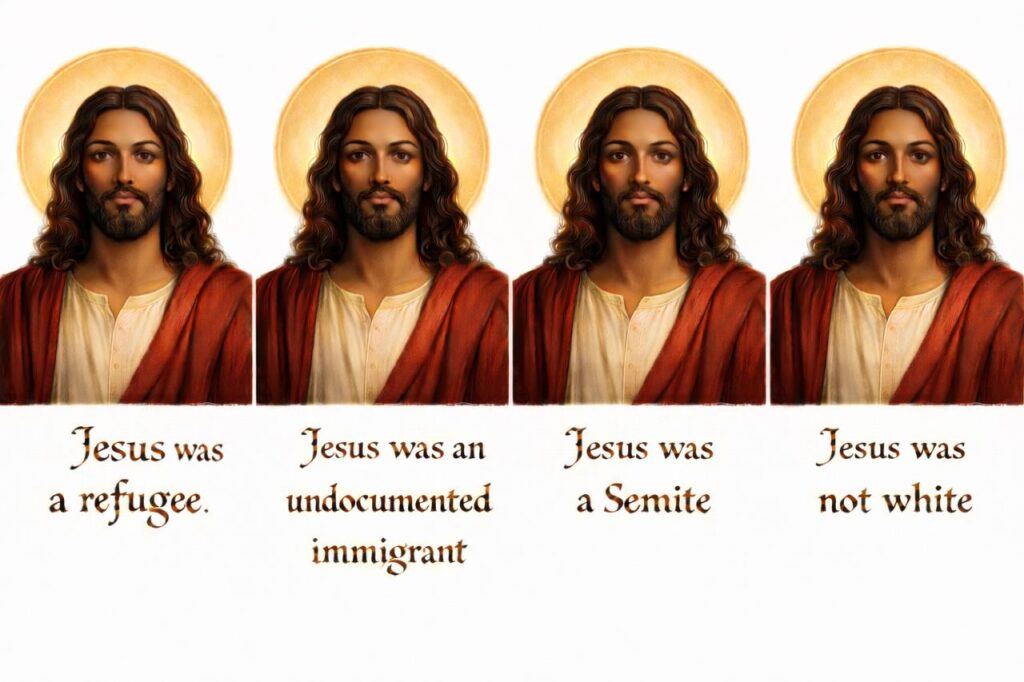
That liminal space between holiday festivities in 2025 and the return to structured weekdays in 2026 offered me the space and time to consider the promise and the perils of AI. I was witness to an explosion of AI-generated memes that presented the interrelated history of Hanukkah and the Christmas story, alongside the barrage of images of Gaza and the genocide of Palestinian Christians and Arabs. I posted a blog on several platforms—SubStack, LinkedIn and the HARP website—called All I Really Need to Know about Palestine, I learned in Sunday School. The images that inspired my current analysis include an AI-generated image of the Holy Family as refugees and undocumented immigrants alongside white supremacist images of Trump’s MAGA Christian nationalism, such as images of immigrants being deported from America often to countries and languages that were unfamiliar; memes that spread false information about colonial history and Indigenous rights; news of Trump’s regime dismantling USAID; and AI and starvation paired as weapons of war in Gaza. The 5-year anniversary of the Insurrection on the Capitol in Washington DC, has drawn social media attention to MAGA Christian nationalism and the Christian symbols, flags, and Bible verses that rioters exploited (on Epiphany of all days).
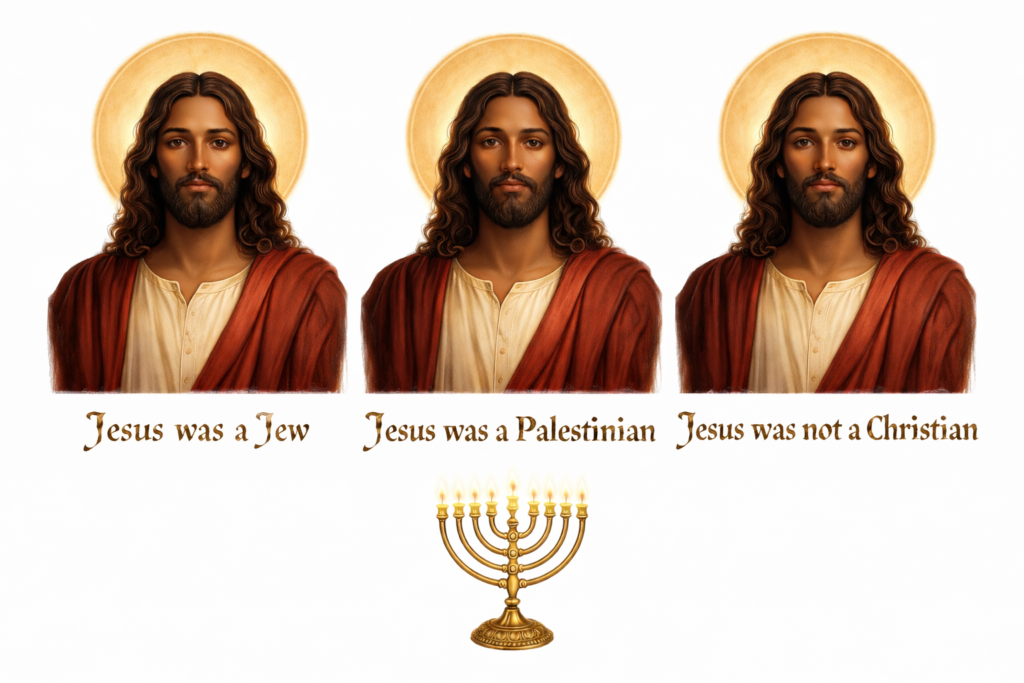
The text accompanying AI images with evidence from the holy books like the Bible, Torah, and Quran ranged from declaring Jesus was a Jew here; to Jesus was a Palestinian there; and Jesus was a refugee elsewhere. Other AI texts repeated passages of scripture to challenge the cruelty of MAGA Christian nationalism that was anything but Christian, specifically Matthew 25:35-40:
For I was hungry and you gave me food, I was thirsty and you gave me drink, I was a stranger and you welcomed me, I was naked and you clothed me, I was sick and you visited me, I was in prison and you came to me. Truly I tell you, whatever you did for one of the least of these brothers and sisters of mine, you did for me.

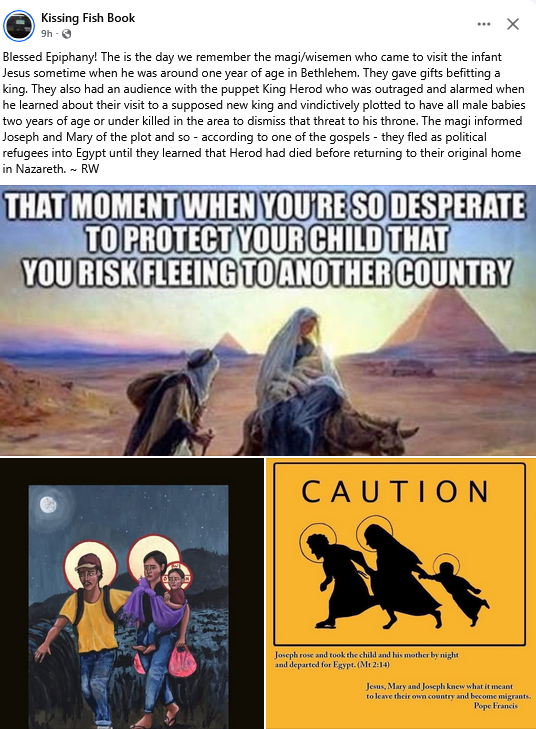
On Christmas Day 2025, an Antigonish pal of mine, Anuj Jain, created an AI-image for his Big Matters, Small Matters SubStack, a Canadian riff on the Christmas story of the three wise men bringing gifts to Baby Jesus at the stable in Bethlehem. Gift-giving is central to the January 6th celebration of Epiphany, also known as Three Kings Day, Little Christmas, Old Christmas, and Orthodox Christmas.

I was inspired to create my first AI-generated image of a brown-skinned Jesus. In keeping with the circulating “Jesus was a Jew” meme, I imagined a young Jesus lighting the menorah during the eight days of the Hanukkah festival of lights. This was what Chat GPT generated in line with my directions:
I had a blast creating these images—so much fun! But wait, I’m in that liminal space, remember, where I could not avoid the other memes exploding on my social media platforms, highlighting the damage caused by AI to Mother Earth.
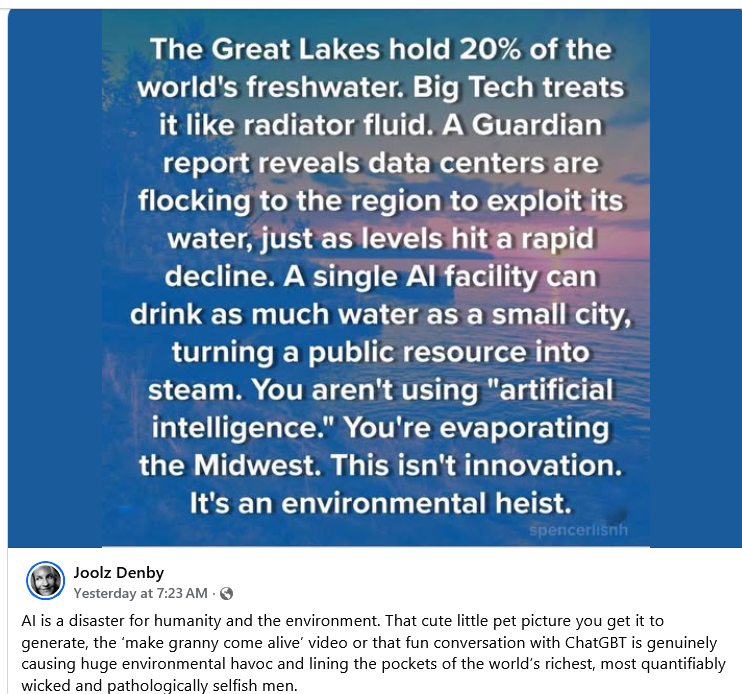
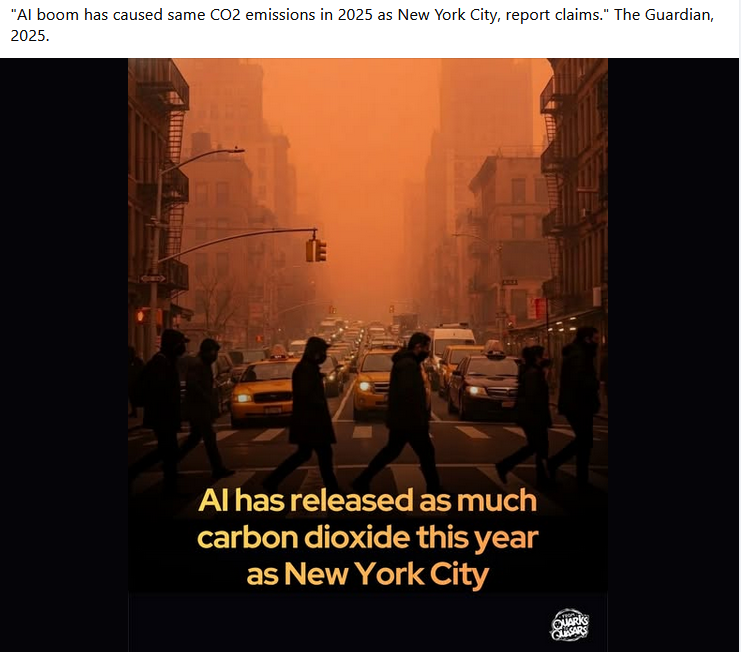

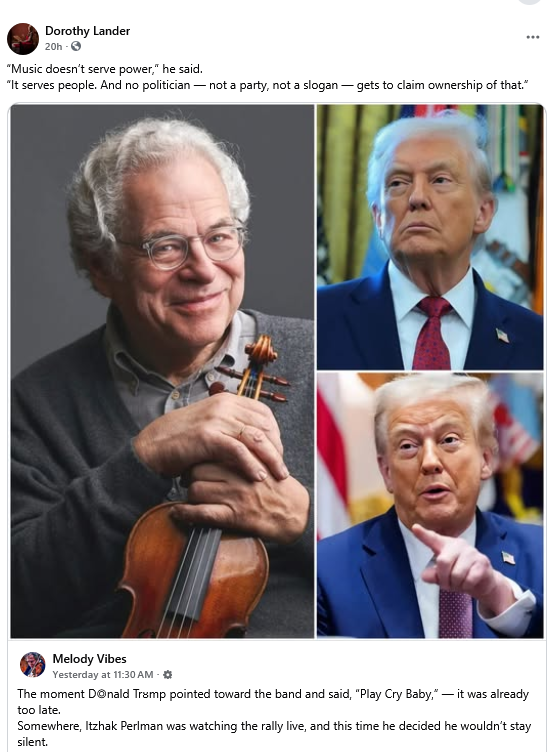
Then again, in this liminal space of the festive season—with visions of sugarplums and peace on earth dancing in my head—I got taken in royally, even with the avalanche of warnings about how AI is fake and dangerous. I wanted to believe that Itzhak Perlman really did take on the Truth Social bully. I shared this AI-generated meme because of an undeniable truth buried in what turned out to be fakery. It is a truth that “the meaning of that music [Play Cry Baby] is emotion, connection, humanity…not a political weapon,” even though Itzhak never did state these words directly to the bully-in-chief.”
This was a turning point. I became determined to try out my new learning about AI-generated illustrations to create an AI monster. I googled to evaluate various free alternatives to ChatGPT that I had used to create the Jesus images. AI responded immediately:
Several free alternatives to ChatGPT are available. The best option depends on your needs. Top choices include Google Gemini, Claude, Microsoft Copilot, and Perplexity AI. All are accessible via free tiers. Here is an evaluation of some free alternatives:
Only a robot monster could be that responsive. I was set to create the ultimate AI monster. I imagined it with the body of a giant water vacuum, a Frankenstein-like head, and multiple lower hoses siphoning water out of the Great Lakes and multiple upper hoses spewing both lies and CO2 into the very air we breathe. These were my explicit instructions to ChatGPT, Microsoft Copilot, and Google Nano Banana. I tried them all. And again the responses were invitational in a “humanish” kind of way, to borrow the title of Justin Gregg’s best-selling book.
Would I care to choose between “Dark Mythic Oil Painting, Graphic Political-Poster Style, Hyper-Reality Fantasy,” or … or …?
“Which of these filters—Punch or Golden or Radiate—would you prefer?”
Here is the image I came up with— after several edits and encouragement from AI, naturally. As the new year dawned, I pledged to stop creating any more AI images, once I had fulfilled my purpose of putting my AI UnTruth Water Vac Monster out into the world.

It seemed fitting to post this image to coincide with Epiphany and the monstrous Insurrection Day in the US, both occurring on January 6th, to illustrate my own very human epiphany.
The epiphany? We humans need to spend less time with the monsters, all of them fake, and more time in the real world, in communion with one another and Nature.