By Dorothy Lander
In a recent posting on LinkedIn, Tye Farrow introduced his doctoral research and the concept of Architectural Determinants of Health (AD0H) as the health-causing features and patterns of placemaking that translate and extend social, structural, and environmental determinants, showing how purposeful design choices become practical levers to support health and wellbeing. In keeping with our healing arts publishing house (HARP The People’s Press: www.tryhealingarts.ca) dedicated to the healing arts for health equity, and our mantra, “A healthy community knows its history,” I began to explore how place history factored into purposeful design choices “constructs” population health and wellbeing, impacting whole communities, cities, and nations. And how health and wellbeing is de(con)structed when place history is neglected or buried completely.
Example 1: Deconstructing Health
Republican-appointed Judge Richard Leon’s 35-page ruling of April 1, 2026 that halted construction of a 90,000-square-foot, $400 million state ballroom by the Trump administration to replace the White House East Wing, qualifies as an embodied, multisensory condemnation of the impact of this construction on the nation’s health and stress levels. Judge Leon used 18 exclamation marks, beginning with “The President of the United States is the steward of the White House for future generations of First Families. He is not, however, the owner!” Along with italics, they are stress marks in every sense. Sam Combs, an Alaska–based architect, sent a written statement ahead of hearing, which uses embodied words to reinforce the national distress caused first by demolishing the East Wing and then This: “The scale and location of the proposed ballroom creates an extreme imbalance of the White House. It would reduce the Mansion to the ‘tail wagging the dog.’ This is untenable and should be stopped.”

The East Wing of the White House, designed in 1902 for symmetry with the West Wing, and its demolition constitutes a “moral injury,” a soul wound resulting from actions—or inactions—that transgress deeply held moral beliefs, often involving betrayal by authority. The loss of the East Wing and Trump’s vanity ballroom project are the source of deep distress and psychological harm.
Example 2: Constructing Health
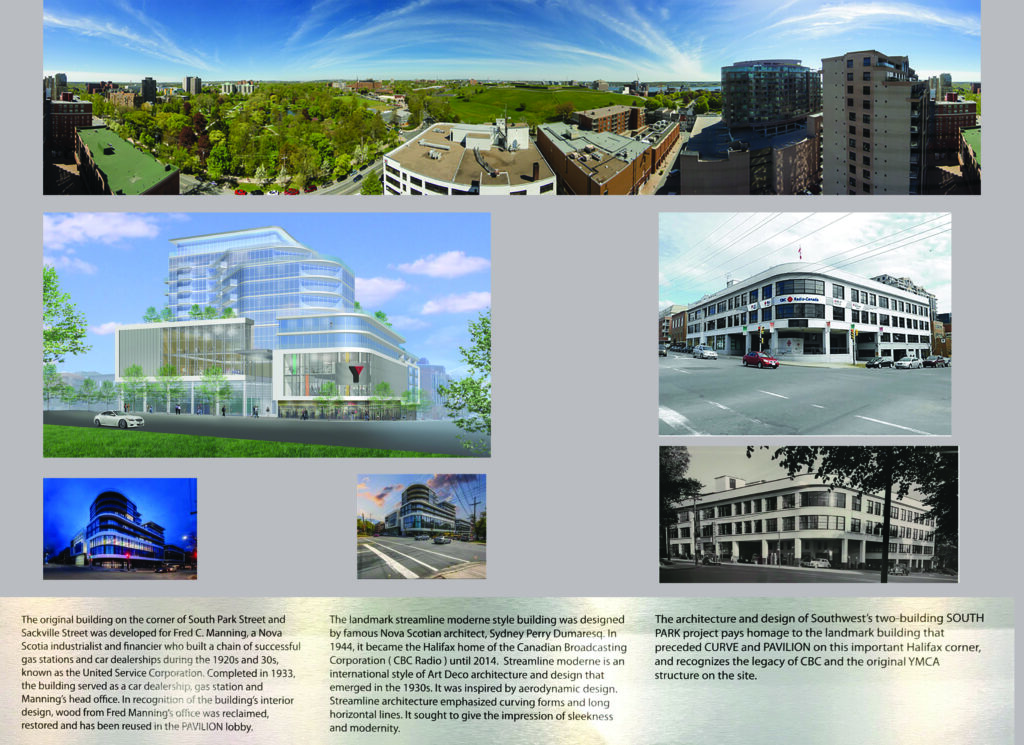
The Pavilion on the Park, developed by Southwest Properies at the corner of Sackville and South Park streets in central Halifax, opened in January 2020, on the previous site of CBC radio and the YMCA. The Pavilion constructs health by honouring and celebrating place history.
Bruce Norman, of Norman Flynn Designs explained how “the overall design was inspired by the CBC building itself, paying tribute to the Art Deco architecture of the building.” The building was originally designed local architect Syndey Perry Dumaresq for Fred Manning in the 1930s, a Nova Scotia businessman who built a chain of gas stations and car dealerships during the 1920s and 30s. Originally a car dealership, gas station and Manning’s head office, the building was designed in the “Streamline Moderne-style,” a 1930s variation of Art Deco known for its elegant curves. In 1944, the CBC moved into the building and it became a downtown landmark. CBC stayed in that building until 2014. Norman elaborated further: “In the design of the presentation suites we even went as far as reusing and retrofitting some of the original interior staircase railings… It looks to me that the architect (Page + Steele Architects) also references this style when designing the exterior of the building, with its strong horizontal lines and curves.”
PAVILION is also home to the new advanced Y in Halifax. The John W. Lindsay YMCA features 70,000 sq.ft. of health and fitness facilities, including a running track, state-of-the-art gym, and pool.
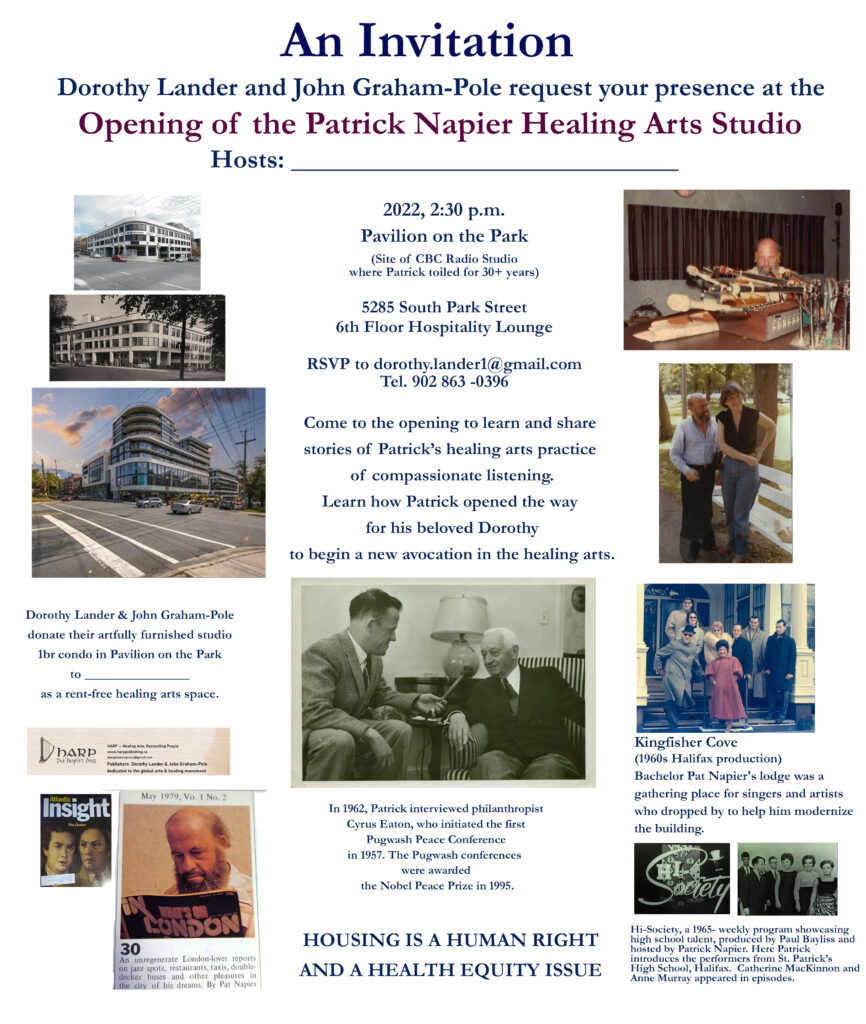
I have a personal connection with the Pavilion on the Park because my husband Patrick Napier, who died in 2004, was a host of several radio programs, including Radio Noon (now Maritime Noon) and The Afternoon Show. My decision to purchase the smallest unit in the Pavilion reinforces Tye Farrow’s observation that “multisensory architectural design causes deep and meaningful connections between the human body and the environment.” Our claim is that memory and history embedded in architectural design animate these deep and meaningful connections, and help us navigate transitions, both personal and communal. I can continue to re-member Patrick walking to work across the Halifax Commons and entering the building from Sackville Street going up to Studio B on the second floor. I created this poster for the grand opening of our unit in the Pavilion.
Example 3: Deconstructing Health
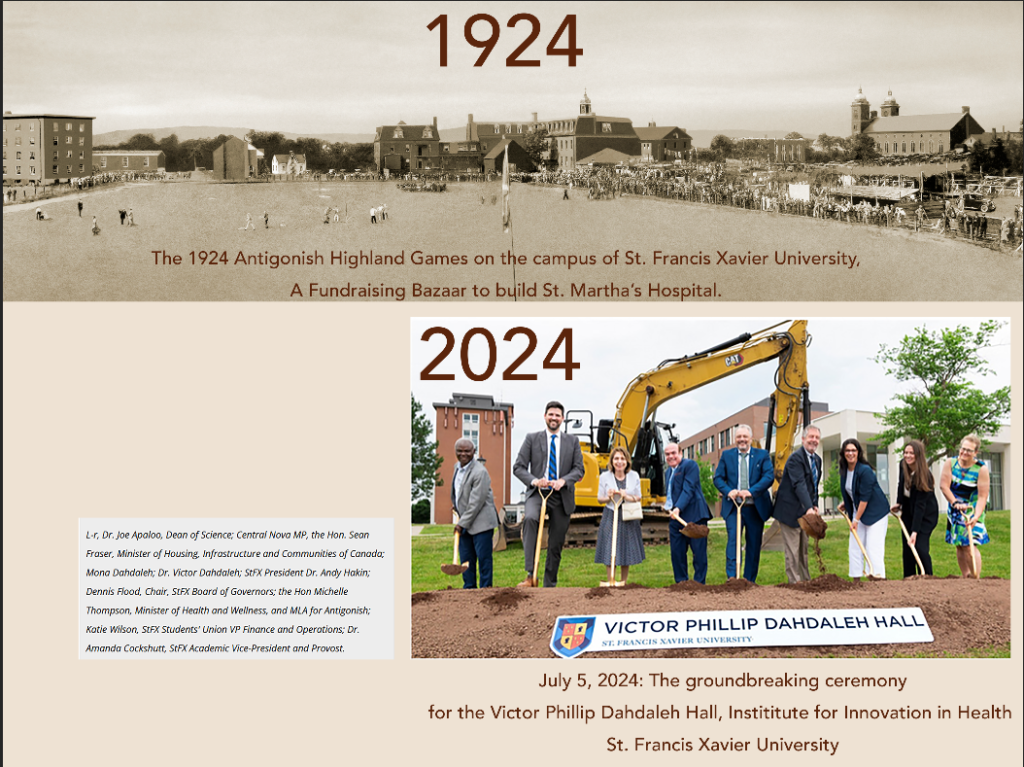
The construction of the Victor Dahdaleh Hall at St. Francis Xavier University in Antigonish, Nova Scotia, housing the Institute for Innovation in Health does not honour place history. The modern building in early stages of construction in 2026 is on the original grounds of Mount St. Bernard, the first Catholic university in North America to grant degrees to women. The very naming of the building for this billionaire donor and aluminum magnate, the middleman and corruption accomplice for Alcoa, constitutes a betrayal by the institution’s power structure and inflicts moral injury on the community of alumni, faculty, staff and students who hold to Whatsover Things Are True (Quaecumque sunt vera). The new hall to house the Institute of Innovation in Health now taking shape fails to echo any of the symmetry, architectural or historical, with the neighbouring MSB halls with saintly names of Marguerite, Gilmora, Immaculata, Camden. The ahistorical naming of this hall buries the history of StFX’s founding mothers (Congregation of Notre Dame). Saint Marguerite Bourgeoys (1620–1700) was a French-born educator and missionary who founded the Congregation of Notre Dame (CND) in 1658 in Ville-Marie (now Montreal). Known as the “Mother of the Colony,” she was the first female saint of Canada, canonized in 1982.
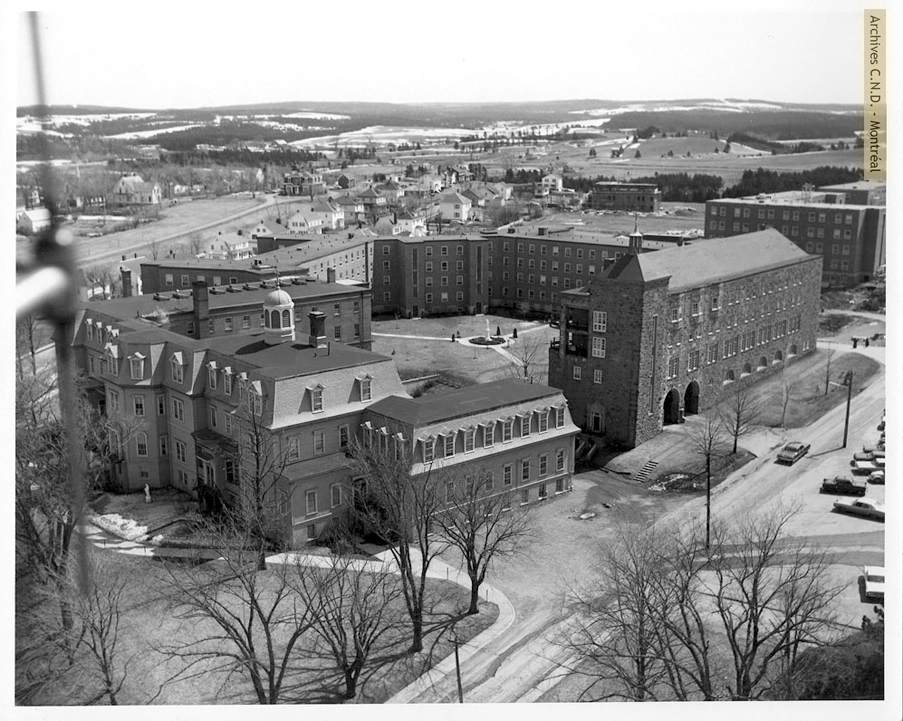
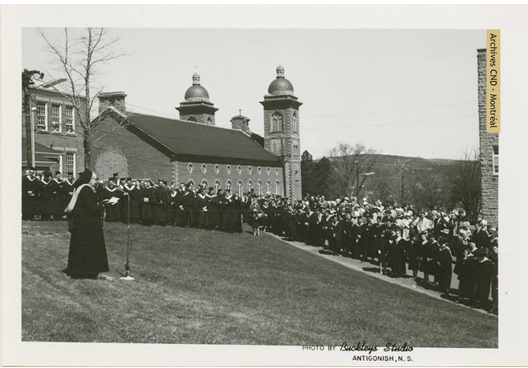
The Golden Jubilee celebrations for Mount St. Bernard College in 1934 on the very site of the new construction. Graduates are standing between Gilmora Hall and St. Ninian’s Cathedral.
In the groundbreaking ceremony for the new hall in 2024, there was no representation or recognition of Mount St. Bernard College. Early posts enlarge on the moral injury and soul wounds arising from the ahistorical approaches to the new construction. https://tryhealingarts.ca/speaking-truth-to-power-speaking-truth-to-history/)