What does Nan Goldin’s Artwork have to do with GIVING VOICE to the Less Powerful of Harvard, StFX, and Palestine?
Follow the Money. A commitment to truth and justice marks the resistance of the less powerful against the exercise of

WATER IS LIFE
A Settler Child Celebrates the Legal Personhood of Pemadeshkodeyong/Rice Lake
by Dorothy Lander
A landmark announcement during the “Giving Rights to Nature to Strengthen Climate Action” COP30[1] event at the Canada Pavilion on November 21, 2025 in Belem, Brazil on the doorstep of the Amazon, transported me to my childhood home in southern Ontario. Alderville First Nation Chief Taynar Simpson officially announced the recognition of the legal personality and rights of Pemadeshkodeyong/Rice Lake.
This resolution grants legal personhood to our dear Rice Lake, which has been our home for 10,000 years, and it will have repercussions for generations to come. We have a duty, for the next seven generations, to do everything in our power to protect the nibi, the water, our source of life.
This recognition positions Pemadeshkodeyong/Rice Lake not merely as a resource, but as a subject of intrinsic rights. This is a first in Ontario, paving a powerful and inspiring path for other communities.
I grew up on the south shore of Rice Lake, my home for only eighteen years—barely an instant compared with the millennia that Indigenous peoples have lived with and cared for this lake. Rice Lake was also the setting of Catharine Parr Traill’s 1852 children’s book Canadian Crusoes: A Tale of the Rice Lake Plains, the first work of fiction for young readers written by a Canadian settler. Each morning of my childhood, looking out toward the rolling hills and the lake from our family farm, I absorbed a view that shaped my earliest sense of place. Rice Lake was my playground—you can find me in the off-the-shoulder swimsuit (Smile) for boating fun with my siblings and cousins circa 1949.
[1] COP30 stands for the 30th meeting of the Conference of the Parties to the UN Framework Convention on Climate Change (UNFCCC). The “parties” are the countries that signed the 1992 UN climate treaty.
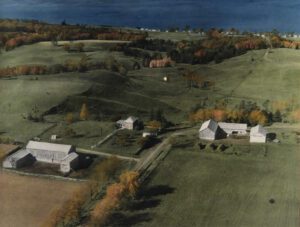
Aerial view of Lander Farm Overlooking Rice Lake, 1980s.

The Lander children and their cousins at Tower Farm, Rice Lake, circa 1949.
Chief Simpson, in a 98.7 FM Northumberland radio interview with journalist Robert Washburn, contrasted the legal personhood of Rice Lake with the earlier recognition granted to the Magpie River / Muteshekau Shipu. “You can’t take a drink from Rice Lake now,” he observed. Yet when I was a child in the 1950s and 1960s, we could—and did. My father and Uncle George, both farmers, built and sold lakeside cottages to Torontonians seeking summer homes. They could not have foreseen today’s overfishing, invasive species, clogged weed growth, and pollution—conditions that galvanized Elders, knowledge keepers, and their allies to draft the resolution recognizing the reciprocal responsibilities between people and the lake.
Fast forward to 2021 and the pandemic, by which time I had been living in Antigonish, Nova Scotia for over 40 years. During the lockdown, my husband and I decided to read aloud to each other first thing every morning. My first choice was Canadian Crusoes by Catharine Parr Traill (CPT), which my dad had read aloud to us four children over several consecutive Sundays some 65 years earlier. This was long before I understood the meaning of “colonization,” “white supremacy,” “unceded land,” and “we are all treaty people” or the need for campaigns like Every Child Matters and MMIWG.
Within moments of that first lockdown reading, I was flooded with memories of my childhood in Rice Lake. I burst into tears. Slapped awake, I suddenly realized we had been complicit in settler colonization. This led me to write my decolonizing memoir ReReading Catharine Parr Traill: Stranging the Familiar, which was launched on Truth and Reconciliation Day a year later in St. George’s Chapel at Gore’s Landing, Rice Lake. This launch was attended by citizens of Alderville First Nation, who also responded with their stories.
Along with Koren Smoke and Skye Anderson and her children Damien and Leila, we placed orange and white flowers for Every Child on the grave of Catharine Parr Traill’s grandchild Henry Strickland Atwood, who aged three, died in January 1864 from chickenpox followed by scarlet fever.
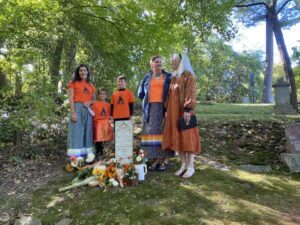
L to R: Skye Anderson, Leila, Damien, Koren Smoke, Dorothy Lander at the grave of Henry Strickland Atwood, St. George’s Chapel, Gore’s Landing, Rice Lake, Ontario, Sept. 30, 2022
In the course of writing my memoir, I reunited with my 1950s Girl Guide Leader Norma Martin (now in her 99th year), who co-authored Gore’s Landing and the Rice Lake Plains (1986). Her fact-checking and critical responses to early drafts of my memoir enriched the final publication.
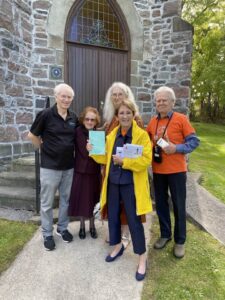
L to R: Trevor Joice (sound engineer 89.7 FM Northumberland), Norma Martin, Dorothy Lander,
Mandy Martin (Mayor, Cramahe Township), John Graham-Pole.
St. George’s Chapel, Gore’s Landing, Rice Lake, National Truth and Reconciliation Day, Sept. 30, 2022
CPT’s tale of the once pristine Rice Lake and its Indigenous stewards echoes Chief Simpson’s statement of Anishinaabe philosophy—”mino bimaadiziwin, a ‘harmonious way of life’ comparable to El Buen Vivir, or Sumak Kawsay, an Indigenous Andean and Amazonian worldview.” It is also comparable to the Water is Life chant that we learned in the water ceremony performed by Mi’kma’ki/Nova Scotia Grassroots Grandmothers and Water Protectors Dorene Bernard and Marion Nicholas. Mi’kmaq elders emphasize that water is the lifeblood and a gift that sustains everyone and everything on Mother Earth. The Mi’kmaw philosophy of Msit No’kmaq, which translates to “all my relations” encompasses a deep cultural understanding that connects all beings and the environment, not just family and community, but also animals, plants, water, and the land.
It is clear from CPT’s writing in Canadian Crusoes that she understood Indigenous ways of life and recognized that “Rice Lake provided essential resources to the community, and its relationship with manoomin, the wild rice harvested by these Indigenous peoples.”
CPT wrote about the Indigenous sacred relationship with the manoomin. In her 1885 Studies of Plant Life, she presaged the loss of habitat and traditional Indigenous practices; her warning went unheeded:
Formerly we could buy the Indian Rice in any of the grocery stores at 7s per bushel, but it is much more costly now as the Indians find it much more difficult to obtain. Confined to their villages, they have no longer the resources that formerly helped to maintain them. … The Wild Rice is now only a luxury in their houses; by and by the Indians will disappear from their log houses and villages and will be known only as a people that were and are not. I am not aware of any other edible plant that is indigenous to Canada.
For Traill, “indigenous” remained a botanical term; her reflections reveal both her observational acuity and the colonial blind spots of her era.
Images of harvesting manoomin/wild rice at Rice Lake from the John Boyd 1921 collection, Library and Archives Canada, are featured in the CBC Radio Canada’s online report of the recognition of legal personhood for Rice Lake, as well as in my memoir ReReading Catharine Parr Traill. Koren Smoke, Cultural Program Advisor for Alderville First Nation, created several images for my memoir, including one of harvesting wild rice that is reminiscent of John Boyd’s 1921 photo.
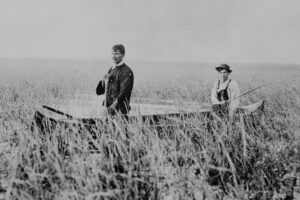
Two Ojibwe men from Mississauga (Michi Saagiig Nishnaabeg)
harvesting wild rice (manoomin) at Rice Lake (Pemadeshkodeyong) in 1921
PHOTO: JOHN BOYD/ LIBRARY AND ARCHIVES CANADA/ FONDS JOHN BOYD FUND/ PA-984653
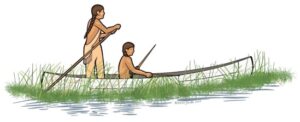
ILLUSTRATION: KOREN SMOKE, MICHI SAAGIIG ANISHINAABE KWE, CULTURAL PROGRAM ADVISOR, ALDERVILLE FIRST NATION
(p. 72, ReReading Catharine Parr Traill, 2022)
Maurice Switzer, citizen of the Mississaugas of Alderville First Nation, authored the memoir’s Foreword. He situates the story within the historical harm of the Williams Treaty of 1923, which stripped Indigenous peoples of their rights to harvest food on their own lands and waters. His account underscores the urgency of enforcing rights now recognized in law:
My maternal grandfather Moses [Muskrat Marsden] was born in the Rice Lake Plains. … While serving as Alderville First Nation Chief from 1904-09, he and other community leaders tried to get the provincial and federal governments to honour treaty agreements they had made and keep settlers from squatting on their lands. He was in the room on Nov. 19, 1923, when government commissioners promised Alderville headmen that agreeing to the Williams Treaty would enable them to continue their way of life.
They lied.
For almost a century, members of the seven Williams Treaty communities were forced to hunt, fish, and trap in secrecy because the treaty commissioners had misled them. … They claimed the Indians had literally surrendered their rights to feed themselves as they always had in their traditional territories. (p. 10)
Unbeknownst to me the Elders and Knowledge Keepers of Alderville First Nation were drafting the resolution in 2024 to officially recognize the legal personhood of Rice Lake. At the same time on the East Coast, I was collaborating with the Mi’kmaw Elders and Knowledge Keepers of Paqtnkek Mi’kmaw Nation and their settler allies in creating a dramatic podcast performance entitled Estuary and Piping Plover Find Their Voice: https://tryhealingarts.ca/harp-podcast/. Episode 2 pleads for legal personhood for Antigonish Harbour and the more-than-human species like the endangered piping plover for whom this estuary is home. This podcast series came in the wake of the decision of the Nova Scotia Department of Fisheries and Aquaculture (NSDFA) to award a commercial oyster fishery—23000 cages spread over 90 acres—to one settler family, without any assessment of the current environment, or any archaeological assessment of the nearby centuries-old burial grounds of the Mi’kmaq. The Mi’kmaw Nation was never approached to give informed consent, as is called for by the Truth and Reconciliation Commission. In the final Episode, Elder John R. Prosper has a conversation with Estu and Plove and prays the rosary for his ancestors in unmarked graves near the large-scale oyster fishery in Antigonish Harbour, already in its first year of operation.
The plea for legal personhood for Estu and Plove in Episode 2 presents as precedent the Magpie River in Quebec, the first in Canada to receive this recognition. My delight and amazement then to learn that Yenny Vega Cárdenas, lawyer and president of the International Observatory for the Rights of Nature, who helped draft the first joint declaration of personhood and rights for the Magpie River /Muteshekau-Shipu also supported Alderville in drafting Rice Lake’s resolution.
I hear in the words of Chief Simpson and Yenny Vega Cárdenas echoes from the Grassroots Grandmothers of Mi’kmaki:
Water is Life and Msit No’kmaq /All My Relations.
I share their belief that these landmark resolutions can inspire communities across Canada and beyond, advancing the COP30 theme of Mutirão—collective action.
I take courage from Yenny Vega Cárdenas’s remarks:
“We no longer need governments, from top to bottom, to propose initiatives. Today, they can come directly from communities, and in this case, from Indigenous communities invited to participate in this collective effort to protect the environment.”